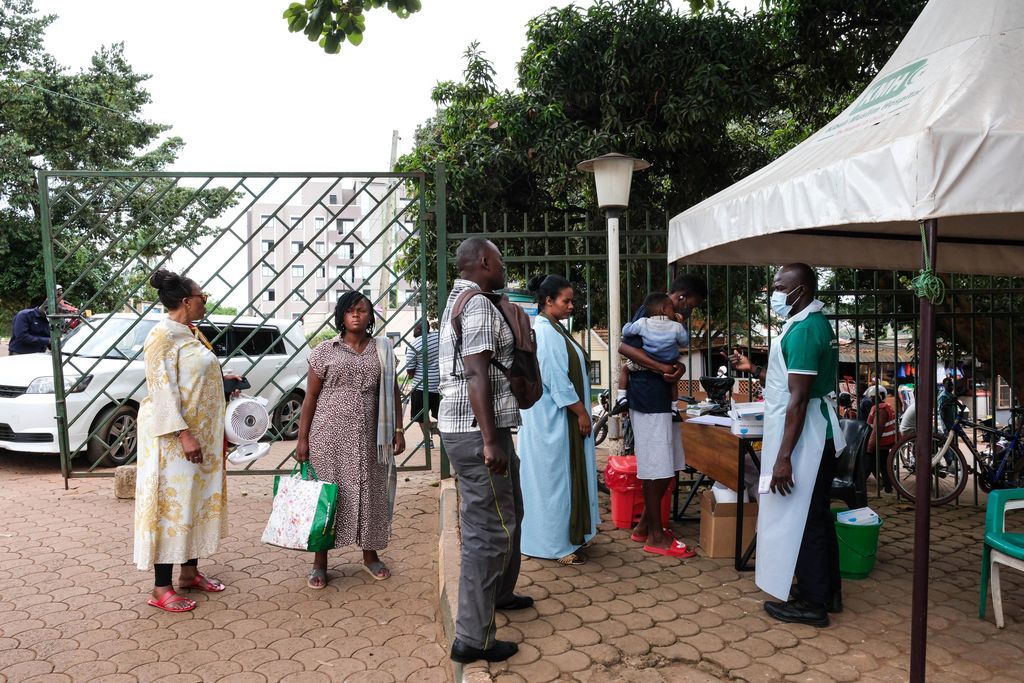

The World Health Organization declared the Ebola disease outbreak caused by a rare virus in Congo and neighboring Uganda a public health emergency of international concern on Sunday, after more than 300 suspected cases and 88 deaths.
WHO said the outbreak doesn’t meet the criteria of a pandemic emergency like COVID-19, and advised against the closure of international borders.
WHO said on X that a laboratory-confirmed case has also been reported in Congo’s capital, Kinshasa, which is about 1,000 kilometers (620 miles) from the outbreak’s epicenter in the eastern province of Ituri, suggesting a possible wider spread. It said the patient had visited Ituri and that other suspected cases have also been reported in North Kivu province, which is one of Congo’s most populous and borders Ituri.
On Sunday, the rebel government of Goma, eastern Congo’s largest city, said in a statement that the first confirmed case of Ebola was detected in the city. The infected person traveled from Ituri province and was currently under isolation, the statement said. Goma was the site of a rapid rebel offensive in early 2025, and the conflict between the Congolese armed forces and the Rwanda-backed M23 rebel paramilitary group has displaced hundreds of thousands.
Ebola is highly contagious and can be contracted via bodily fluids such as vomit, blood or semen. The disease it causes is rare, but severe and often fatal.
WHO’s emergency declaration is meant to spur donor agencies and countries into action. By WHO’s standards, it shows the event is serious, there is a risk of international spread and it requires a coordinated international response.
In a separate statement on X on Sunday, the WHO Regional Office for Africa said that a team of 35 experts from the WHO and the Congolese Ministry of Health had arrived in Bunia, the capital of Ituri province, along with 7 tons of emergency medical supplies and equipment.
The global response to previous declarations has been mixed. In 2024, when WHO declared mpox outbreaks in Congo and elsewhere in Africa a global emergency, experts at the time said that it did little to get supplies like diagnostic tests, medicines and vaccines to affected countries quickly.
It’s hard to treat a variant of Ebola
Health authorities say the current outbreak, first confirmed on Friday, is caused by the Bundibugyo virus, a rare variant of the Ebola disease that has no approved therapeutics or vaccines. Although more than 20 Ebola outbreaks have taken place in Congo and Uganda, this is only the third time that the Bundibugyo virus has been detected.
Congo accounts for all except two of the cases, both of which were reported in Uganda, WHO said.
The Bundibugyo virus was first detected in Uganda’s Bundibugyo district during a 2007-2008 outbreak that infected 149 people and killed 37. The second time was in 2012, in an outbreak in Isiro, Congo, where 57 cases and 29 deaths were reported.
Dr. Richard Kitenge, chief of operations at the Centre des Opérations d’Urgence de Santé Publique, part of Congo’s National Institute of Public Health, recently arrived in Ituri. He said that while the risks may be high, Congo has weathered previous outbreaks.
“We have managed enough epidemics in the country without treatment. The Zaire virus, which we managed, was also untreated in several epidemics, and not everyone died,” Kitenge told The Associated Press.
Conflict and migration complicate efforts
Africa Centres for Disease Control and Prevention Director-General Dr. Jean Kaseya said Saturday that a high number of active cases remain in the community, particularly in Mongwalu, where the first cases were reported, “significantly complicating containment and contact tracing efforts.”
Violent conflict with militants, some backed by the Islamic State group, as well as constant population movement because of mining, both within Congo and across the border in Uganda, have also posed a major challenge to response efforts.
Officials first reported the spread of the disease in Ituri province, close to Uganda and South Sudan, on Friday. On Saturday, the Africa CDC reported 336 suspected cases and 87 deaths in Congo.
“There are significant uncertainties to the true number of infected persons and geographic spread associated with this event at the present time. In addition, there is limited understanding of the epidemiological links with known or suspected cases,” WHO Director-General Tedros Adhanom Ghebreyesus said.
The two cases in Uganda include one person whom officials said had traveled from Congo and died at a hospital in Uganda’s capital, Kampala, and another WHO said had also traveled from Congo.
WHO said the high percentage of positive cases among samples tested, the spread to Kampala and Uganda and the clusters of deaths across Ituri “all point toward a potentially much larger outbreak than what is currently being detected and reported, with significant local and regional risk of spread.”
Congo outbreak killed 50 before it was detected
Kaseya said that slow detection delayed the response and gave the virus time to spread.
“This outbreak started in April. So far, we don’t know the index case. It means we don’t know how far is the magnitude of this outbreak,” Kaseya said, using a term for the first detectable case of an epidemic.
The earliest known suspected case, a 59-year-old man, developed symptoms on April 24 and died at a hospital in Ituri on April 27.
By the time health authorities were first alerted to the outbreak on social media on May 5, 50 deaths had already been recorded, the Africa CDC said.
WHO said at least four deaths have been reported among healthcare workers who showed Ebola symptoms.
Diagnostics and vaccines problems
Shanelle Hall, principal adviser to the head of Africa CDC, told reporters Saturday that there were four therapeutics under consideration for the Bundibugyo virus, but no vaccine was being actively considered.
A bigger issue is that even existing vaccines and therapeutics for other Ebola viruses aren’t manufactured in Africa. Africa’s struggle to get vaccines from richer countries during the COVID-19 pandemic spurred different efforts to accelerate its capacity to manufacture shots, but resources remain scarce.
Kaseya said the demand for a vaccine for a rare virus like Bundibugyo, which isn’t as deadly as the Ebola Zaire prominent in Congo’s past outbreaks, has been the recurring issue in discussions with pharmaceutical companies over vaccine manufacturing,
“If we are serious in this continent, we need to manufacture what we need,” he said. “We cannot every single day look for others to come to tell us what they are doing.”