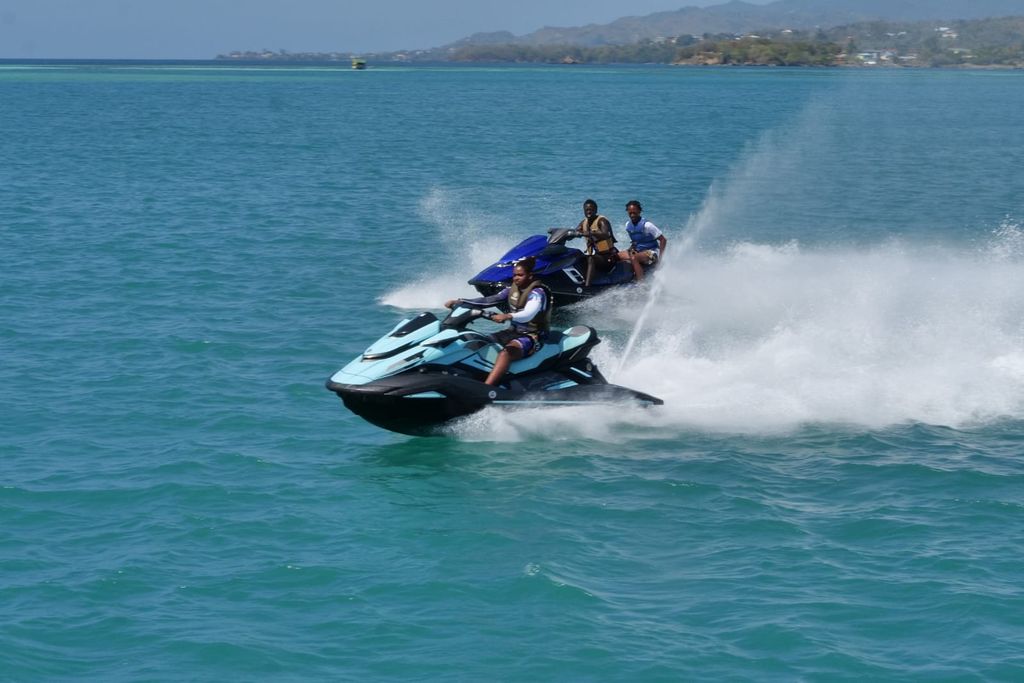

Prime Minister Kamla Persad-Bissessar says Government is in consultation with the Tobago House of Assembly on measures to regulate the use of jet skis and other pleasure craft following the death of seven-year-old Angelica Jogie at Pigeon Point Heritage Park in Tobago last week.
She was responding to a question in Parliament yesterday from Diego Martin North/East MP Colm Imbert, who asked what immediate and urgent action the Government is taking to prevent similar incidents in local waters.
The Jogie family, their Oropouche East community and others in Trinidad and Tobago have called for the regulation of jet ski operations.
Prime Minister, expressing the Government’s condolences to Jogie’s loved ones, said, “The Government is in constant communication with the THA regarding measures to address these matters, and more will be said in the future—so we’re in consultation … with these kinds of matters.”
Persad-Bissessar claimed there was a bill in 2020 that “would have helped to address matters such as these, but those on the other side sat on that bill for ten years or more, until last year, and never acted on that bill.”
Prime Minister, however, gave no details of the THA communication and consultation, when it would be concluded and if it involved any or all parts of the 2020 bill.
Prime Minister also did not indicate if her Government would speak with the Jogie family, or if representatives would attend Angelica’s funeral, which is at 9 am today.
The funeral is from the family’s home at Cemetery Street, Monkeytown, followed by cremation.
Oropouche East MP Dr Roodal Moonilal visited the Jogie family’s home on Monday, speaking with Angelica’s grandmother and other relatives.
Meanwhile, PNM Tobago Council leader Ancil Dennis has blamed the United National Congress for the stalling of the Marine Park Bill, which was passed by the THA in November 2020.
The former chief secretary said the then-opposition refused to support the Tobago autonomy bill in December 2024.
The bill, which required a special majority to pass, failed as 21 government members voted in favour of it while 16 opposition members voted against.
Dennis said the Marine Park Bill would have given the THA the necessary teeth to manage the marine park properly.
The bill imposes a $2,500 fine for unauthorised access to the park or 12 months’ imprisonment.
It also covers permitted noise levels, unauthorised use of jet skis, requirement for insurance of vessels and bans the sale and distribution of alcohol. The penalties for infractions include fines up to $20,000 and/or two years’ imprisonment.
He said the THA, under his tenure as chief secretary, did its part to ensure the marine park was safe for the public.
In the wake of renewed concerns over jet ski safety, Jamaica Tourism Enhancement Fund executive director Dr Carey Wallace says decisive action—even unpopular—may be necessary to protect lives.
In an interview with Guardian Media yesterday, Wallace weighed in on the issue, noting that Jamaica was forced to make difficult decisions regarding jet ski use.
He recalled that in 2014, American tourist Tomas Torres Castillo was struck and killed by a jet ski while bathing near his hotel in Negril.
A year earlier, seven-year-old Jamaican girl Tanoya Hyman lost her life after an Indian tourist lost control of a jet ski and slammed into her while she was playing in the sand. The operator was charged with manslaughter but found not guilty.
Wallace said these incidents were part of a pattern that ultimately led to the government banning all commercial jet ski operations around 2017.
“You would have had an outcry from the public as well as an outcry from tourism stakeholders ... We had no choice but to ban jet skis. We banned the importation of jet skis and stopped giving licences to any operator in watersports, and we would impose fines and seize the crafts if they were caught (operating illegally). That translated into significant reductions to the point where we haven’t had a case since then.”
He said the accidents not only affected the country’s tourism reputation but also had financial consequences.
Wallace noted that, like Pigeon Point and Store Bay, Jamaica has designated swimming zones, but enforcement remained a challenge due to limited resources and cultural attitudes toward compliance.
He acknowledged the decision was difficult, given that tourism accounts for over 30 per cent of Jamaica’s GDP, and said some operators remain opposed. However, he said there are no regrets.
Asked whether the ban affected tourist arrivals, Wallace said there was no evidence of negative fallout.
He advised Trinidad and Tobago stakeholders to make a data-driven decision, balancing public safety and livelihoods.
“You have to make it a data-driven decision instead of an emotional one. You have to look at your numbers, your pros and cons, for your government to make a decision accordingly.”