
Senior Reporter
an[email protected] Minister Kamla Persad-Bissessar has confirmed that the Government will move to exempt private pension income from tax through the Finance Bill, 2026, seeking to bring legislative effect to a measure that had been promised in the Budget but remained outstanding months into the fiscal year.
Her statement in Parliament yesterday follows a Business Guardian lead story last Thursday, headlined: Retirees Still Paying As Govt Misses Pension Tax Deadline.
Persad-Bissessar told the House she was authorised by Cabinet to clarify the position, outlining that income derived from approved pension fund plans and approved deferred annuity plans will be exempt from income tax once the legislation is passed.
The exemption will apply to income earned on or after January 1, 2026, including for individuals who have been contributing to existing plans for years.
“This Government was elected on a clear promise: to put people first, to ease the burden on working families and to ensure that after a lifetime of contribution, our citizens can retire with dignity and peace of mind,” she said.
Prime Minister described the reform as a significant step within the tax system, arguing that pension income should not be treated in the same way as other forms of earnings.
“A pension is not a windfall. It is not a bonus. It is the result of years, sometimes decades, of sacrifice, discipline and commitment. It represents foregone consumption today in order to secure tomorrow,” she said, adding that the policy is intended to reward that discipline rather than penalise it.
Persad-Bissessar said the measure forms part of a broader commitment outlined in the United National Congress manifesto and reiterated in the 2026 Budget Statement, positioning it as both social policy and economic support for retirees.
“It means leaving more money in the hands of our citizens. It means empowering retirees to meet their needs, support their families and participate in the economy.
“It means encouraging a culture of savings and long-term planning,” she told Parliament.
The debate in the House intensified when Opposition MP Colm Imbert questioned why public sector pensioners were not explicitly included, pointing to the Government’s earlier commitment that both private and public retirees would benefit from tax exemption.
The exchange brought into focus a key concern about the scope of the reform and whether it will be expanded.
Persad-Bissessar rejected the criticism and defended the rollout, stating that the administration is delivering on its promises.
She framed the measure as part of a wider shift in economic priorities.
“The Government delivers on its promises,” she said.
“The former administration tried to enrich their friends, but we are enriching the workers. We stand on the side of the ordinary taxpayer and not just the few and the rich getting richer, like what the last administration did.”
TTARP welcomes the move
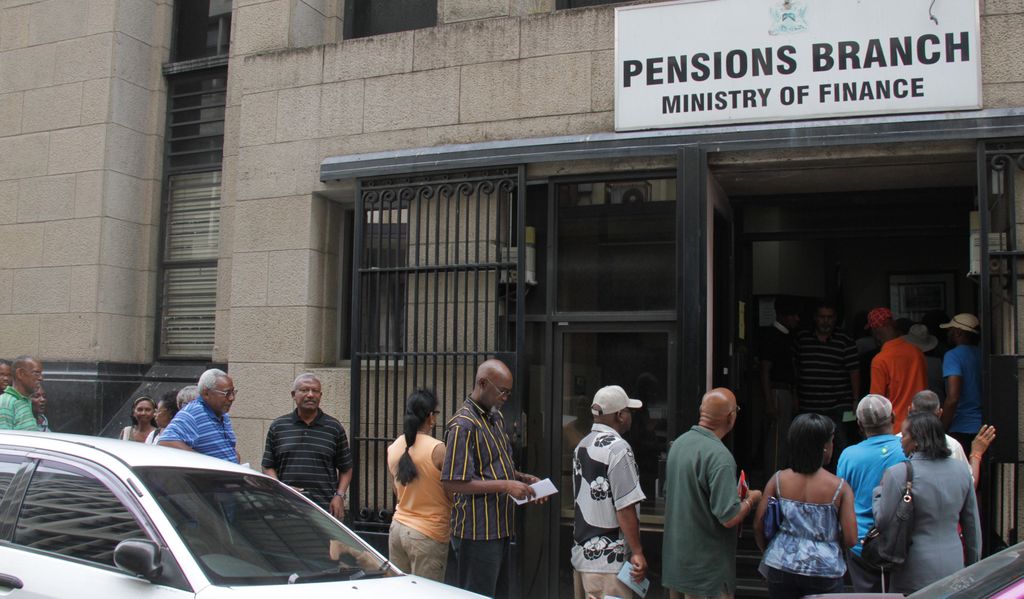
Outside Parliament, the Trinidad and Tobago Association of Retired Persons (TTARP) has remained central to the issue.
The organisation supported the policy when it was first announced, but raised concerns when the enabling legislation did not materialise, leaving pensioners uncertain and still taxed.
Reynold Cooper, TTARP’s first vice-president, said the association had long been advocating for relief, particularly for pensioners whose income exceeds the tax threshold, noting that inflation has eroded the value of pensions over time.
“We had written to them in the past… that we would like pensioners, especially government pensioners, not to pay taxes, especially those like myself who get a pension above $7,500,” he said, pointing to the strain on retirees managing higher living costs.
Contacted yesterday, Cooper welcomed the Prime Minister’s statement, saying he was pleased to hear that the measure will now be implemented, as many pensioners had been struggling with rising food prices, medication and seeing about their household while continuing to pay tax.
He added that there is still hope that public sector pensioners can be included.
The Government also sought to place the measure in context, providing data on the number of taxpayers likely to benefit.
Based on Income Tax Return filings and TD1 declarations for Income Year 2024 received to date, 39,063 taxpayers made claims for annuity contributions.
While this is a decline from 50,715 in 2023, the Prime Minister said it still represents a significant portion of the population.
She added that the majority of these contributors are modest savers, with only 71 individuals making contributions above $100,000 in 2024, compared to 102 the previous year.
The policy will apply specifically to approved and regulated pension and annuity plans, with early withdrawals before retirement or maturity remaining taxable.
The Government indicated that this safeguard is intended to preserve the integrity of the system and ensure the measure supports long-term retirement security rather than short-term tax planning.
Finance Minister Davendranath Tancoo had previously pointed to delays linked to legislative requirements and data verification, noting earlier this year that draft legislation had been prepared and placed before Cabinet after initial challenges in gathering the necessary data.
Retirees hail tax exemption relief
For many retirees, the announcement signals relief after months of uncertainty.
Speaking with Guardian Media, one pensioner said, “As one of the many retirees who have spent a lifetime working, saving, and sacrificing, I say a heartfelt thank you to Prime Minister Kamla Persad-Bissessar for this relief. For most of us living on modest incomes, managing rising healthcare costs and watching our savings shrink, this exemption is a big deal. It is the difference between dignity and hardship.”
Others pointed to the immediate impact on daily living.
George Ramdial said the removal of tax would ease pressure on his monthly income as food and medical costs continue to rise.
Marcia Thomas said the delay between the Budget announcement and legislative action had created uncertainty among pensioners.
Anthony Clarke noted that the measure could encourage stronger savings behaviour among younger workers if confidence in the system improves.
The policy now moves to the legislative stage, where its final scope will be determined.
The question of whether public sector pensioners will be included remains unresolved, even as the Government pushes ahead with what it describes as a major reform to the tax system. For retirees, the focus is now on execution and whether the promised relief will be reflected in their income without further delay.
What pensioners were paying before
Under the existing system, pension income is assessed alongside other income but benefits from a personal allowance of $90,000 annually.
This means a pension of $7,500 per month, or $90,000 per year, falls within the allowance and attracts no tax.
For higher pensions, only the portion above the allowance is taxed.
A monthly pension of $10,000 totals $120,000 annually, with $30,000 subject to tax after the allowance is applied.
One pensioner noted that at that level, monthly tax payments are under $600, not the significantly higher figures sometimes suggested in public discussion.
There is also a structural feature of pension taxation. Contributions to approved plans are typically made from pre-tax income during a person’s working life, meaning taxation has traditionally occurred at the payout stage. The new measure removes that tax on qualifying income, shifting how retirement earnings are treated within the system.