
Tobago Correspondent
Four months after its arrival, the US-supplied military-grade radar system has left Tobago.
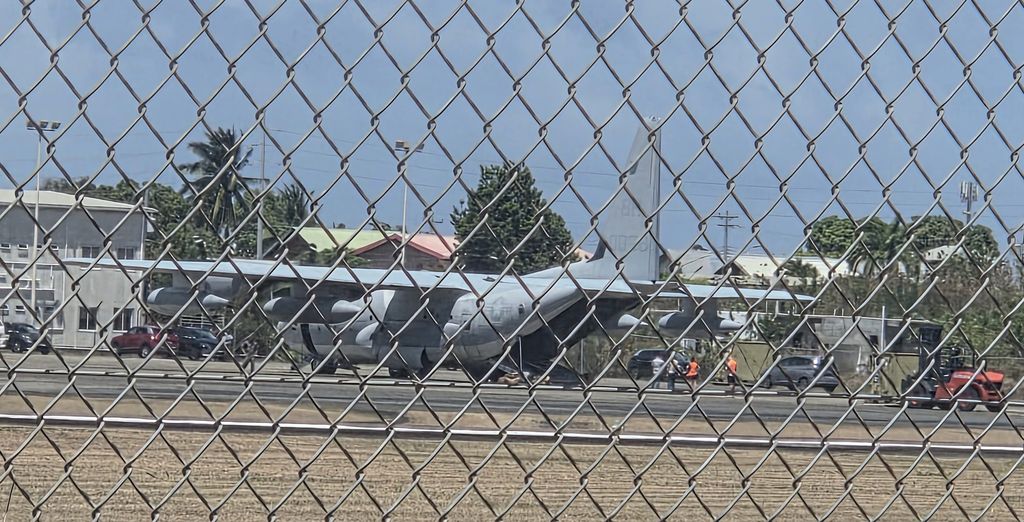
At 11.56 am yesterday, a US military aircraft touched down at the ANR Robinson International Airport in Crown Point.
It stayed approximately two hours at the airport and never switched off its engine.
At a vantage point on the southern side of the airport, Guardian Media could see a forklift loading crates into the back of the aircraft.
Approximately two hours later, the aircraft departed the island headed for Puerto Rico. However, just before it arrived there, it took off its transponder.
The military aircraft’s stop in Tobago came 24 hours after Guardian Media confirmed the dismantling of the controversial radar for its impending removal.
The radar had arrived in Tobago in November amid a shroud of secrecy as Prime Minister Kamla Persad-Bissessar initially declined to reveal its presence and that of US troops. She said she was hesitant to inform the public as it was a matter of national security.
US military personnel have been on the island since November, managing the radar, which reportedly cost US$3 million per day to operate.
They have maintained a consistent presence at Grafton Beach Resort in Black Rock but are expected to depart the island soon.
Chief Secretary Farley Augustine last week said the US troops will be leaving “in a couple of days.”
However, their exact departure date remains unknown owing to “national security reasons.”
In explaining the presence of the radar, Persad-Bissessar previously said it would aid in drug interdiction, particularly out of South America.
Defence Minister Wayne Sturge, during a media conference in Tobago in November, said drug traffickers were using drones to transport drugs to Trinidad and Tobago. He said the radar would assist T&T in keeping up with the technology and clamp down on criminal activities.
Commissioner of Police Allister Guevarro, in December, claimed the radar was instrumental in a $171 million drug bust at the Caroni Swamp.
However, local national security experts had argued that the radar, manufactured by Northrop Grumman, is not made to track boats, but instead missiles.
The Opposition has insisted the radar was used as a tool to force regime change in Venezuela. On January 3, the US forcibly removed then-Venezuelan President Nicolas Maduro in a military operation in Caracas. He is currently in the US facing drug trafficking charges.
Economist Dr Vanus James yesterday said he was delighted the radar was gone and said Tobago did not get any value from its presence.
“It’s just serving the American interest, I’m glad to see it go,” he said.
James said the lack of transparency by authorities on the matter showed the pressing need for constitutional change.
“There is no mechanism in the country for transparency, accountability or consensus-building. It is time for us to get about the business of setting up a constitutional arrangement under which we can get what we dream of for accountability, transparency and consensus-oriented government.”
He said small-island states would continue to suffer and fight like “crabs in a barrel” if changes to governance structures are not made.
“It’s a consequence of an inadequate and inappropriate system of government, from Cuba right down to T&T and Guyana.”
He warned small-island states to beware of imperialist agendas or risk returning to the colonial days.
“That didn’t prove to turn out so well for us, and if we go back there, it wouldn’t turn out well again, if history is to be our guide.”
Meanwhile, regional security expert Dr Garvin Heerah said the absence of the radar has created “an operational vacuum that must be carefully assessed.”
He said, “If the system played the role previously communicated to the public, namely assisting in the monitoring of illicit maritime movements, then its absence may reduce early detection capability in one of the most sensitive maritime corridors in the region. In the fight against transnational organised crime, surveillance gaps can be quickly exploited by sophisticated trafficking networks involved in narcotics, illegal arms movements, and human trafficking.”
He said the focus should be on building sustainable systems to ensure security is not compromised.
“Countries must ensure that core elements of their national security architecture, particularly border surveillance, maritime monitoring, and intelligence gathering, remain nationally owned and controlled.”