
As oil and gas prices soar against the backdrop of the war in Iran, the United States and Western exporters could find a new opportunity to fill the gap in the market.
As the conflict enters its sixth day on Thursday, here is a closer look at the situation.
Why is a global oil and gas crisis mounting?
There are two main reasons: Shipping through the vital Strait of Hormuz has been disrupted; and energy infrastructure in Gulf countries has been attacked, affecting operations.
Strait of Hormuz
Shipping through the Strait of Hormuz between Iran and Oman, which carries one-fifth of oil consumed globally and about 20 percent of the world’s liquefied natural gas (LNG), has come to a near halt after vessels in the area were hit by Iran earlier in the week in retaliation for US and Israeli strikes, which began on Saturday.
Iran’s Islamic Revolutionary Guard Corps (IRGC) declared on Monday that the strait was “closed” and that any vessel attempting to pass through the waterway would be set “ablaze”.
The US-flagged product tanker, Stena Imperative, was damaged by “aerial impacts” while berthed in the Middle East Gulf, the vessel’s owner, Stena Bulk, and its US manager, Crowley, said in a statement on Monday. The impact killed a shipyard worker.
IRGC said it had hit the Honduran-flagged Nova with two drones and left it burning in the Strait of Hormuz, Iranian news agencies reported on Tuesday.
In all, at least five tankers have been damaged, two personnel killed and about 150 ships stranded around the strait.
Advertisement
The disruption and fears of prolonged closure have caused oil and European natural gas prices to jump, with Brent crude futures up as much as 13 percent as the conflict triggers multiple oil and gas production shutdowns in the Middle East.
About 10 percent of the world’s container ships are currently caught up in the broader backups, and cargo could soon start piling up at ports and transshipment hubs in Europe and Asia, Jeremy Nixon, CEO of container carrier Ocean Network Express, known as ONE, said on Monday.
The tankers are clustered in open waters off the coasts of major Gulf oil producers, including Iraq and Saudi Arabia, as well as LNG giant Qatar, according to ship tracking data from the MarineTraffic platform.

Energy infrastructure attacked
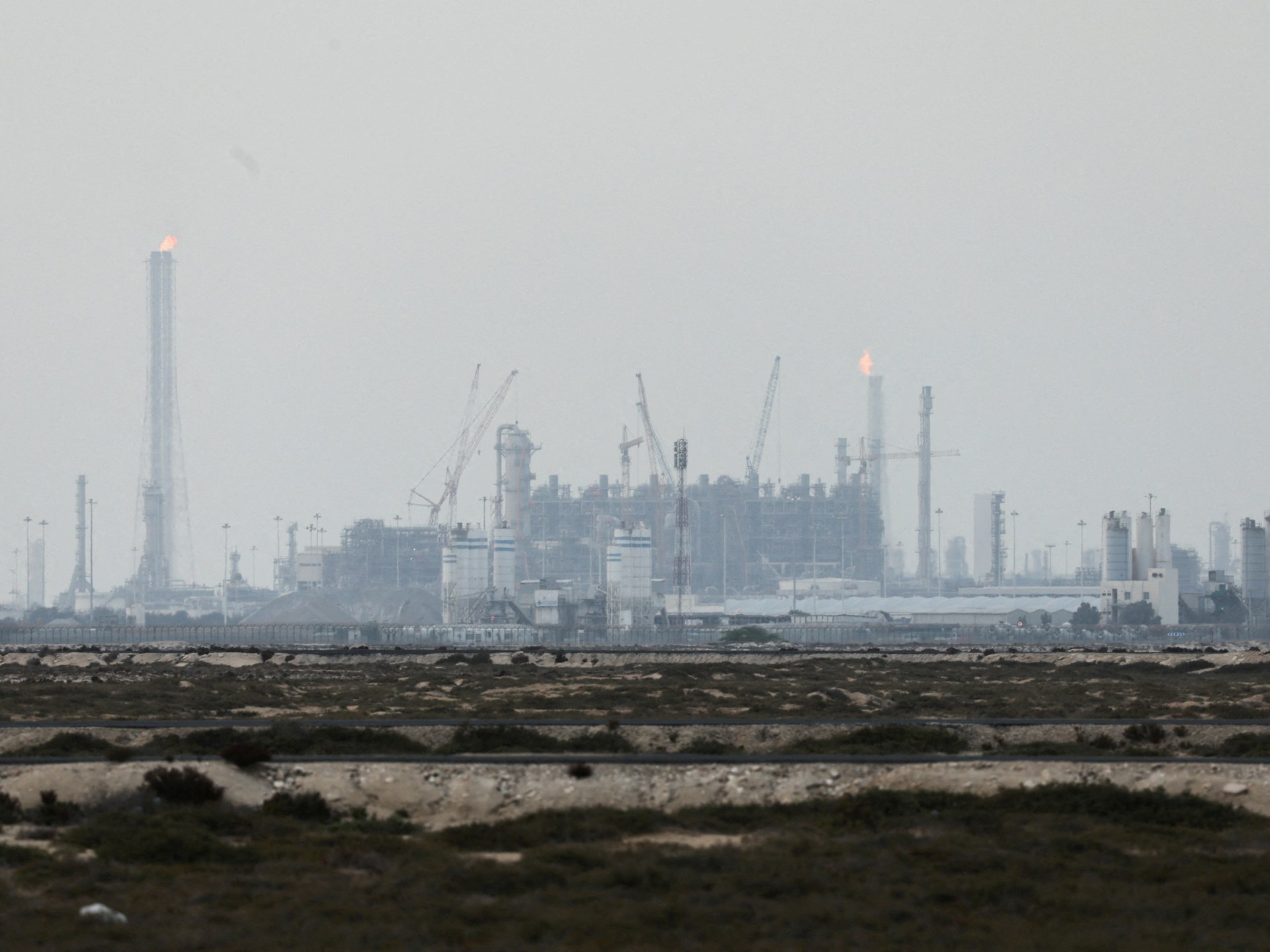
Qatar’s state-run energy firm and the world’s largest producer of LNG, QatarEnergy, announced on Monday that it had halted LNG production following Iranian attacks on its operational facilities in Ras Laffan and Mesaieed in Qatar.
Iranian officials have publicly denied targeting QatarEnergy.
Saudi Arabia shut down operations at its Ras Tanura plant, its largest domestic oil refinery, which is operated by Saudi Aramco, after a fire broke out at the facility, which officials said was caused by debris from the interception of two Iranian drones.
Iran’s Tasnim news agency quoted an unnamed Iranian military source saying: “The attack on Aramco was an Israeli false flag operation.” The source added that Israel’s goal was “to distract the minds of regional countries from its crimes in attacking civilian sites in Iran”.
“Iran has announced frankly that it will target all American and Israeli interests, installations and facilities in the region, and has attacked many of them so far, but Aramco facilities have not been among the targets of Iranian attacks so far,” the source told the agency.
How much oil and gas does the region produce?
The Strait of Hormuz carries about one-fifth of oil and LNG consumed globally from Gulf producers like Saudi Arabia, Iraq, the United Arab Emirates, Kuwait and Qatar, which is the world’s third largest LNG exporter.
Any disruption to traffic through the strait affects gas markets in Asia and Europe.
The Middle East is also home to five of the world’s seven largest oil reserves. Nearly half of the world’s oil reserves and exports come from the region.
After Venezuela, which has 303 billion barrels of oil reserves, Saudi Arabia holds the world’s second-largest proven crude oil reserves, estimated at 267 billion barrels. Iran has 209 billion barrels, Iraq has 145 billion barrels, the UAE has 113 billion barrels and Kuwait has 102 billion barrels.

In addition to crude oil, the Middle East is a global powerhouse for natural gas, accounting for nearly 18 percent of global production and approximately 40 percent of the world’s proven reserves.
Advertisement
Who is most reliant on Middle East oil and gas?
Asia and Europe rely heavily on Middle Eastern oil and gas.
China, India, Japan and South Korea are the top buyers of crude that passes through the Strait of Hormuz. In 2024, these Asian countries cumulatively accounted for 69 percent of all Hormuz crude oil and condensate flows.
On Thursday, South Korea, which imports 20 percent of its gas from the region, said it could run out of LNG in nine days. South Korean President Lee Jae Myung has announced the creation of a 100 trillion won ($68.3bn) stabilisation fund to cope with soaring energy prices.
“These are substantial losses to global energy markets and cannot be easily replaced,” Neil Quilliam, a Middle East and North Africa programme fellow at the United Kingdom-based Chatham House, told Al Jazeera.
Quilliam explained that countries that are part of the International Energy Agency (IEA), a Paris-based autonomous intergovernmental organisation, such as the US, China, India and Australia, generally hold strategic petroleum reserves and commercial stocks.
In case of a short-term but major disruption, these reserves can be tapped into.
“The issue of production is another matter,” he said. “So far, the Iranian strikes against energy assets in the Gulf have not caused untold damage, so as long as production can return when the strait opens, then markets will take some comfort from that.”
What has happened to oil and gas prices?
Oil prices rose on Thursday.
Brent crude was up by $2.35, or 2.9 percent, to $83.75 a barrel by 08:50 GMT. US West Texas Intermediate (WTI) crude was up $2.42, or 3.2 percent, at $77.08.
European diesel futures reached their highest level since October 2022 at $1,130.
Who gains from all this?
With energy production shut down or prevented from shipping in the Middle East, the US is now the world’s largest oil exporter. It is also the world’s largest LNG producer.
Before halting production, Qatar supplied LNG to buyers in Europe and Asia. QatarEnergy’s suspension of LNG production creates a huge gap which Western gas exporters, such as US firms like ExxonMobil and Cheniere, could exploit. Australia, which ships about 11 billion cubic feet per day (bcfd), has a few spot cargoes to plug the supply gap in Asia, Quilliam said.
However, US producers will not be totally unharmed by the general rise in prices and increasing production is not something which can be achieved overnight.
“The US is mostly insulated from the oil price increase, given that it is now the world’s largest crude exporter; however, it will import higher prices, given that the country imports refined products and that will be felt at pump,” Quilliam said.
“The US should be able to capitalise upon the loss of Qatari LNG and absorb market share, though it would take months for companies to increase production to take advantage of conditions and by then the crisis may well be over. In theory, the US can benefit from the current disruptions, but much depends on the longevity of the war.”
Advertisement
While the US is the world’s largest LNG producer, its plants are running near full capacity, Quilliam said, and most cargoes are already locked into long-term contracts.
Global gas consumption is about 400bcfd, energy analysts estimate. Roughly 55bcfd is LNG, with the US, Australia and Qatar accounting for about 60 percent of global output, according to the International Gas Union. Most of that LNG is sold under long-term contracts.
Furthermore, new US production, which could come online soon, is unlikely to exceed 2bcfd, far short of the 10bcfd gap left by Qatar – equal to about 80 million tonnes per year, according to Reuters calculations.
Could all this provide a boost to shadow fleet users?
Because of sanctions and other restrictions, a significant share of oil and gas is now moved through a “shadow fleet” of tankers that operate outside normal regulatory oversight. Countries like Russia and Iran often sell oil this way.
“Russia is certainly benefitting from the loss of Saudi and Iranian crude making it to markets and will increase the flow of crude exports to China and India – at higher prices too,” Quilliam said.
“At the same time, to steady markets, there will be little appetite to enforce sanctions against Russia and so its shadow fleet will be more active than usual.”
Related News
Eight bodies found in Libya and Greece as Mediterranean crossings continue
North Korea promotes Kim Jong Un’s sister as he vows to boost economy
UN approves first carbon credits under Paris Agreement market mechanism