
Lead Editor-Politics
akash.sama[email protected]
Prime Minister Kamla Persad-Bissessar has expressed the possibility of an additional United States military presence in this country following the summit with President Donald Trump on March 7. And she has revealed that the US is pumping US$3 million daily into the operations of the radar in Tobago.
Persad-Bissessar and Guyana President Dr Irfaan Ali were this week invited to the Shield of the Americas meeting in Florida. They will be joined by Latin American nations who have publicly declared themselves allies of the Trump administration.
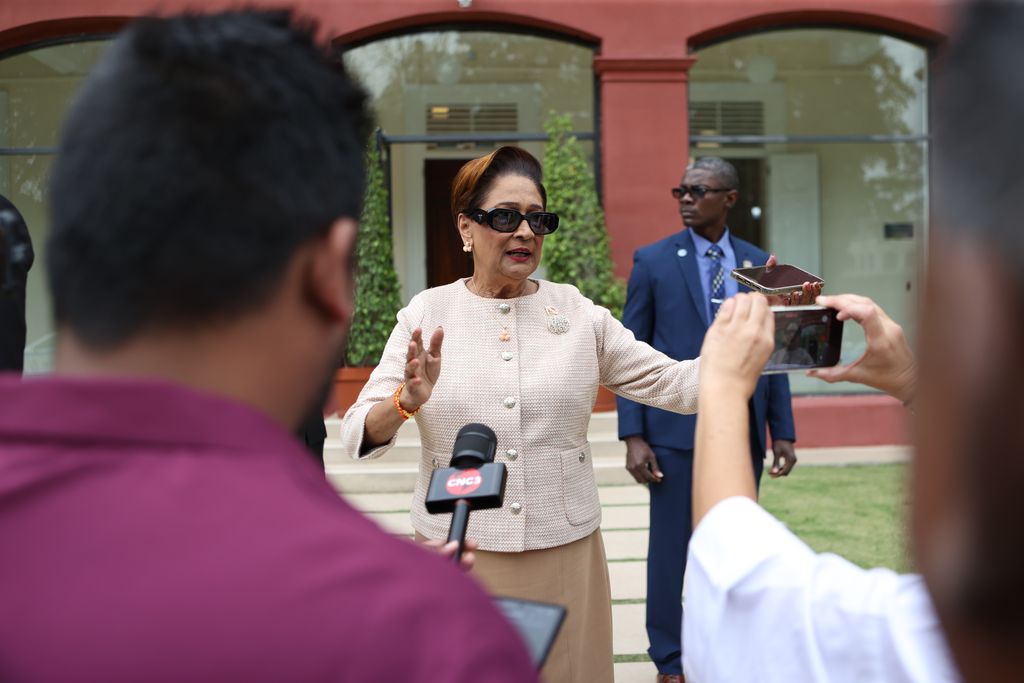
Speaking with Guardian Media outside of the Red House in Port-of-Spain yesterday, the Prime Minister was told there are concerns that this meeting will pave the way for a further US military presence in the country.
“Maybe, maybe not. I can’t pre-empt what will happen at that meeting,” the PM responded.
Persad-Bissessar said safety and security are at the top of the summit’s agenda.
But she again sought to remind the public that military partnerships with the US through the State of Forces Agreement (SOFA) is not new.
“What I want to remind you, it was the former prime minister who signed the SOFA agreement which allows for that. I don’t know why it is a big issue. When that happened, the agreement was already signed when I inherited the governance of the country.”
Asked if this puts the country at the mercy of the US, Persad-Bissessar said, “We are not at the mercy of anyone except the good Lord. And the other ones I am at the mercy of are the people of Trinidad and Tobago. And I will do what I think is best, of course, with the advice of the rest of my cabinet and other stakeholders. So, we are not at the mercy. We can say no, we can say yes.”
Pivoting to the US-installed radar in Tobago, Persad-Bissessar revealed a new piece of information on the high-tech and controversial equipment.
“I don’t know why there was such a big noise because a few people were here from the US military in Tobago with the radar. You know they are paying US$3 million a day for that radar. Not us. They are paying that. Therefore, they kept some of their military personnel there to ensure that the radar would be safe.”
The Prime Minister explained that the US$3 million per day is the US’ operational cost, which includes salaries, accommodation and upkeep. That means in the 93 days since the radar was first spotted at the ANR Robinson International Airport, maintaining the radar would have so far cost the United States US$ 279 million.
Asked how many US military personnel are still in the country, Persad-Bissessar said, “I still can’t say how many because they are leaving in groups. And I am told sometime in March they are proposing to leave.”
However, she added that it is not a “massive amount.”
But the Prime Minister said those soldiers will not have any authority over the people of Trinidad and Tobago.
“From their intelligence that they may gather, my understanding and what I’ve been told, is that they will advise the TTPS, who will then pursue. There was a drug bust not too long ago. It was their intelligence that allowed our TTPS to go in. So, they can’t come and arrest you unless if you’re cuffing them down or something.”
The Prime Minister said she has no regrets for partnering with the US, as it helped curbed the murder rate in this country. Told that there have been claims that it was the State of Emergency that led to that drop in homicides, she replied, “It is both, it is both.”
Guardian Media also asked Opposition Leader Pennelope Beckles for her comment on the Prime Minister saying there is the possibility of a deeper military arrangement with the US following the March 7 summit.
“The Prime Minister saying maybe or maybe not is quite interesting because at the end of the day, we still have not gotten the total details as to exactly what has continued,” Beckles said.
However, Beckles said she does not agree that the US has helped T&T “tame” its murder rate.
“Clearly, that is not the case. If you look at the figure today, the figures suggested for this month, you have more (murders) than this time last month. And we are not aware exactly what is the role the United States is playing at this time as it relates to crime intervention.”