
Derek Achong
A High Court judge has said citizens should not be shut out of the courts because they lack financial resources.
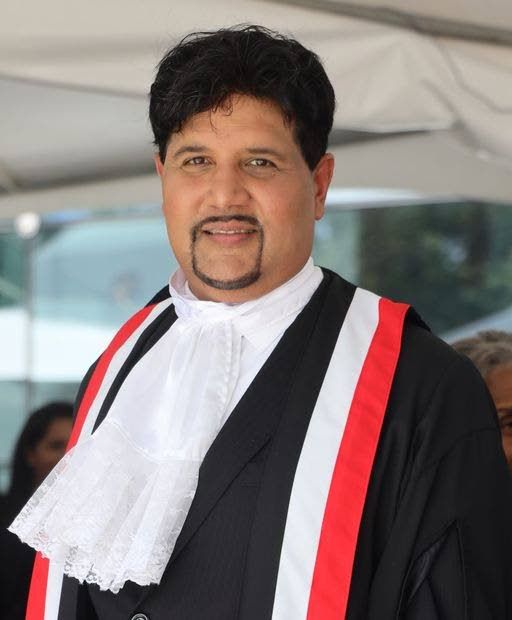
Justice Frank Seepersad made the comment yesterday as he upheld an application by a Point Fortin man to proceed with his medical negligence lawsuit despite filing it outside the statutory time limit.
Justice Seepersad said: “The court does not only serve the wealthy or the connected, it serves all citizens and, irrespective of their circumstance, must ensure that each and every citizen is afforded an opportunity to have reasonable access to the judicial system.”
“This court firmly believes that once it is equitable, fair, and reasonable, it should always judiciously exercise any vested discretion in a manner which aids in the determination of disputes instituted by the poor, vulnerable or disenfranchised and in this case the claimant’s plight cannot be lightly disregarded,” he added.
The claim, brought by Hollis Williams, arose from a hand injury he sustained in a chopping incident in August 2015.
He was taken to the Point Fortin Hospital, where doctors recommended tendon graft surgery at the San Fernando General Hospital.
He complied and later participated in physiotherapy at the hospital’s Orthopaedic Clinic.
Williams continued to experience pain and limited movement in his fingers and was eventually assessed as 10 per cent permanently partially disabled.
In 2019, Williams applied to the Legal Aid and Advisory Authority for assistance in pursuing a negligence claim.
His matter was reassigned several times before officials assigned it to attorney Aaron Patrick, who filed the claim last year.
Williams also said he faced delays because he needed time to source the finances required to retain a medical expert.
Attorneys for the South West Regional Health Authority, which manages both facilities, argued that the court should strike out the claim because Williams filed it outside the four-year statutory period under the Limitation of Certain Actions Act.
In determining the application, Justice Seepersad said the limitation period would have expired in October 2020 but was extended to November 2022 due to the Covid-19 pandemic.
He found that Williams’ explanations for the delay were reasonable.
“The explanations outlined in the claimant’s affidavit cannot properly be characterised as being indicative of conduct which was dilatory or laissez-faire,” Justice Seepersad said.
“It is obvious that he has limited financial resources and although he applied for legal aid, his application was accompanied by challenges,” he added.
Justice Seepersad said Williams only secured the services of the medical expert after Patrick’s appointment in 2023.
“The court readily accepts that there was some delay in acquiring the expert medical report, but the evidence demonstrates that delay which ensued was in large measure attributable to facts and circumstances which were outside the claimant’s control,” he said.
Justice Seepersad said the authority claimed it would suffer prejudice because its staff could not recall details of Williams’ treatment and could not locate some of his medical records.
However, he said Williams would face greater prejudice if the court did not allow him to pursue the claim.
The ruling means Williams’ case will proceed to trial at a later date.
Williams was also represented by Kristen Bansraj and Govinda Tiwari. The South West Regional Health Authority was represented by Anand Ramlogan, SC, Ganesh Saroop, Amirah Ramdass, Seth Ramsden and Vishaal Siewsaran.
Related News
Officer critical after falling from upper level of police station
PNM knocks Kamla for gaslighting on Stink & Dutty traffic chaos

Supreme Court strikes down Trump’s sweeping tariffs, upending central plank of economic ...