
RADHICA DE SILVA
Senior Multimedia Reporter
radhi[email protected]
Activists and migrant advocates are calling on the government to extend the ongoing migrant registration process, warning that many indigenous migrants — particularly members of the Warao community are at risk of being left out due to a lack of documentation and limited access to information.
As the final day of online registration came to a close, almost 100 indigenous migrants gathered in the Moruga Great Hall to complete their online registration, with more travelling from South Trinidad and as far as Arima.
Speaking to Guardian Media, Grand Chief of the First Peoples’ Sovereign Nations in Trinidad and Tobago, Eric Lewis, said the exercise was critical because many indigenous migrants do not possess basic identification documents.
“Some of them have no form of ID and no birth certificates. Some don’t even know their exact date of birth,” Lewis said. “The embassy indicated they would assist with preparing Venezuelan documents so they can be properly registered here in Trinidad.”
Lewis estimates that close to 200 indigenous migrants live in the Moruga area, although many have moved to other parts of the country for work. He said since the registration drive began, approximately 150 adults have been assisted, along with an estimated 40 to 50 children.
He acknowledged that while efforts have been made to reach people, a short extension — possibly one to two weeks — would allow those who were unaware of the process or unable to gather documents in time to comply.
“Not everyone is on social media or follows the news. When you think about an indigenous community, many simply didn’t know registration was happening,” he said.
Among the organisations assisting migrants on the ground were representatives of the United Nations system, including the UNICEF Office for the Eastern Caribbean Area, volunteers, the Venezuelan Embassy and La Casita Hispanic Cultural Center.
Managing Director of La Casita, Andriena Briceno Ventura-Brown, said hundreds of migrants have passed through their outreach efforts in Moruga, Icacos and other communities.
She described widespread confusion and fear among some migrants, particularly those with deportation or separation orders.
“Some people are afraid to come forward. They are afraid of being re-victimised or detained after the process finishes,” she said.
Ventura-Brown is also calling for an extension of one to two weeks and greater direct engagement between Government officials and indigenous leaders to clarify the objectives of the registration exercise.
“We need to speak the same language — not just English and Spanish — but clearly explain the meaning and purpose of this process so people understand what it means for them,” she said.
She also urged employers to cooperate in providing job letters required for registration, noting that some migrants have reported difficulty obtaining documentation from workplaces.
Meanwhile, with the final hours of registration underway, community members and private citizens also stepped in to help. Among them was businessman Valmiki Ramsingh, who sponsored registration fees for two migrants. Singh said it broke his heart to see so many Warao children in the Moruga region. He encouraged the public to come out and support vulnerable indigenous families to help them get out of poverty.
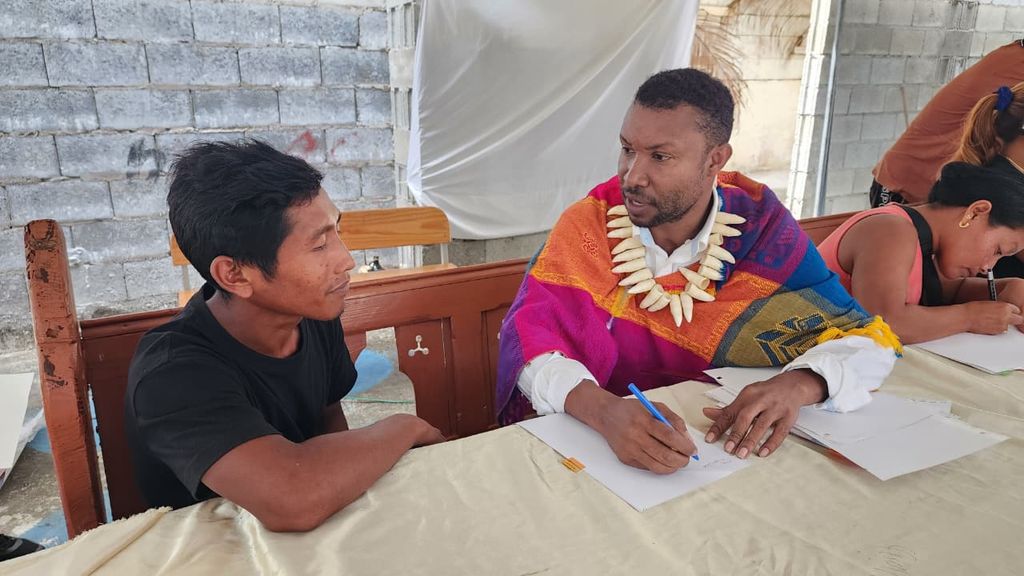
Grand Chief Eric Lewis helps the Warao people to register as migrant registration came to a close on Wednesday.
Related News

Mutilated female body found along M2 Ring Road in La Romaine
Artistes call for greater emphasis on extempo music
Opposition to PM: Retract calypso comments