
Senior Reporter
otto.carring[email protected]
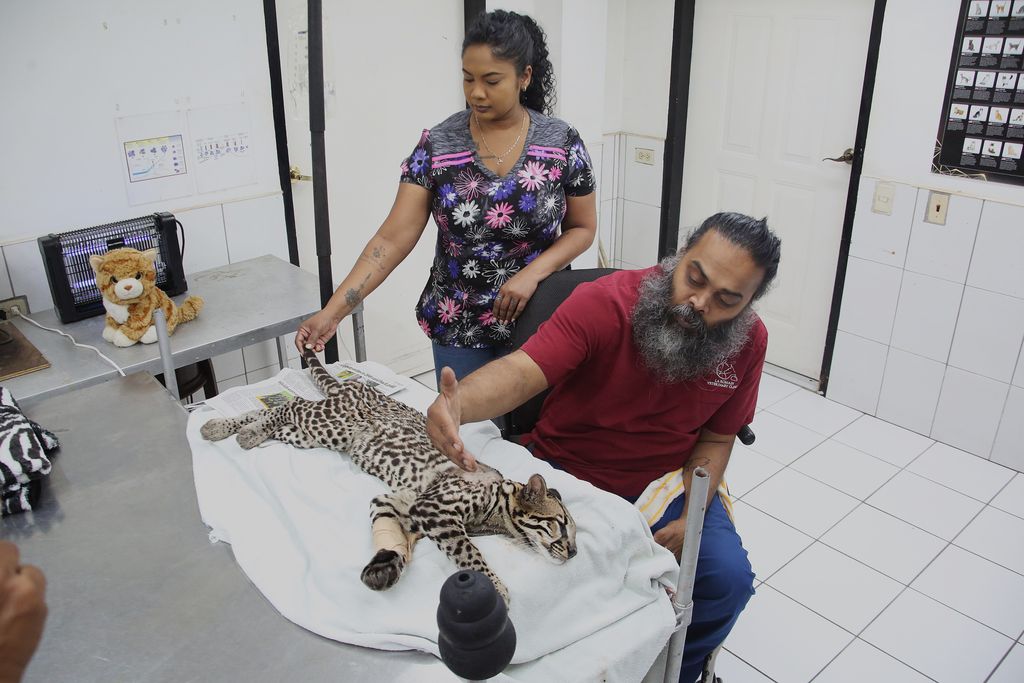
An ocelot is fighting for survival after being shot and left with severe spinal injuries, in what officials are describing as a serious breach of the country’s environmental protection laws.
The animal, now named Papaoutai, underwent emergency surgery after X-rays revealed ballistic trauma to his spine.
While his condition remains critical, veterinarian Dr Kriyaan Singh, who has been caring for him since he was retrieved from a forested area, says there is cautious optimism.
Papaoutai is being kept at the La Romaine Veterinary Clinic in South Trinidad.
“He is currently what we would consider paraparesis. Even though he cannot voluntarily stand up on his hind legs, he does have some voluntary movement. He also has good deep and light pain sensation. That tells us that while there is spinal trauma, it is not a complete severing of the spinal cord,” Singh said of the animal’s current condition.
That distinction, he explained, gives the animal a favourable prognosis but he said the full extent of the injury will only be known after a CT scan scheduled for Friday.
Game warden Steve Persad contacted Singh after receiving video footage of the ocelot in distress in the Cedros-Granville forest on Sunday.
By the time the animal arrived at the veterinary facility several hours later, he was severely dehydrated, in shock and showing limited mobility. A puncture wound beneath the neck initially appeared to be associated with porcupine quills found around the injury site. However, the size and depth of the wound raised suspicion.
“With our experience, we suspected a gunshot wound,” Dr Singh said.
Radiographs confirmed the last two cervical vertebrae and the first three thoracic vertebrae showed damage caused by a ballistic fragment. Emergency surgery was immediately performed to remove the bullet.
Since the procedure, Papaoutai has shown signs of improvement. However, Singh said the CT scan will provide crucial 3D imaging to determine whether additional fragments remain and if further surgical intervention is possible.
“If the CT scan is not favourable, we may have to consider euthanasia. But we are hoping for a full recovery,” Singh said, adding the species is environmentally sensitive and an important part of the nation’s biodiversity.
He was blunt in his assessment of the shooter.
“I don’t want to call this person a hunter. A hunter hunts for food or livelihood. This was not that. I prefer to call them a poacher,” he said.
Based on the recovered fragment, Singh suspects the animal may have been shot with a handgun, possibly a nine-millimetre round.
Singh said this was the fourth reported shooting of an ocelot so far this year, noting the previous three were already dead by the time they were found.
“I’ve had 40 ocelots here over the years. The first three that were shot didn’t make it. We are hoping Papaoutai will be the one who pulls through.”
In a statement, the Ministry of Agriculture and Fisheries acknowledged the incident and confirmed that the ocelot is an Environmentally Sensitive Species (ESS) protected under the Environmental Management Act.
The ministry said the ocelot has full protection from hunting, harm or disturbance, adding the species plays a crucial role in maintaining ecological balance in Trinidad and Tobago by regulating prey populations.
“Any act that jeopardises the life or well-being of an ESS not only undermines national conservation objectives but also contravenes the Environmental Management Act,” the statement said, noting that violations carry a fine of TT$100,000 and up to two years’ imprisonment.