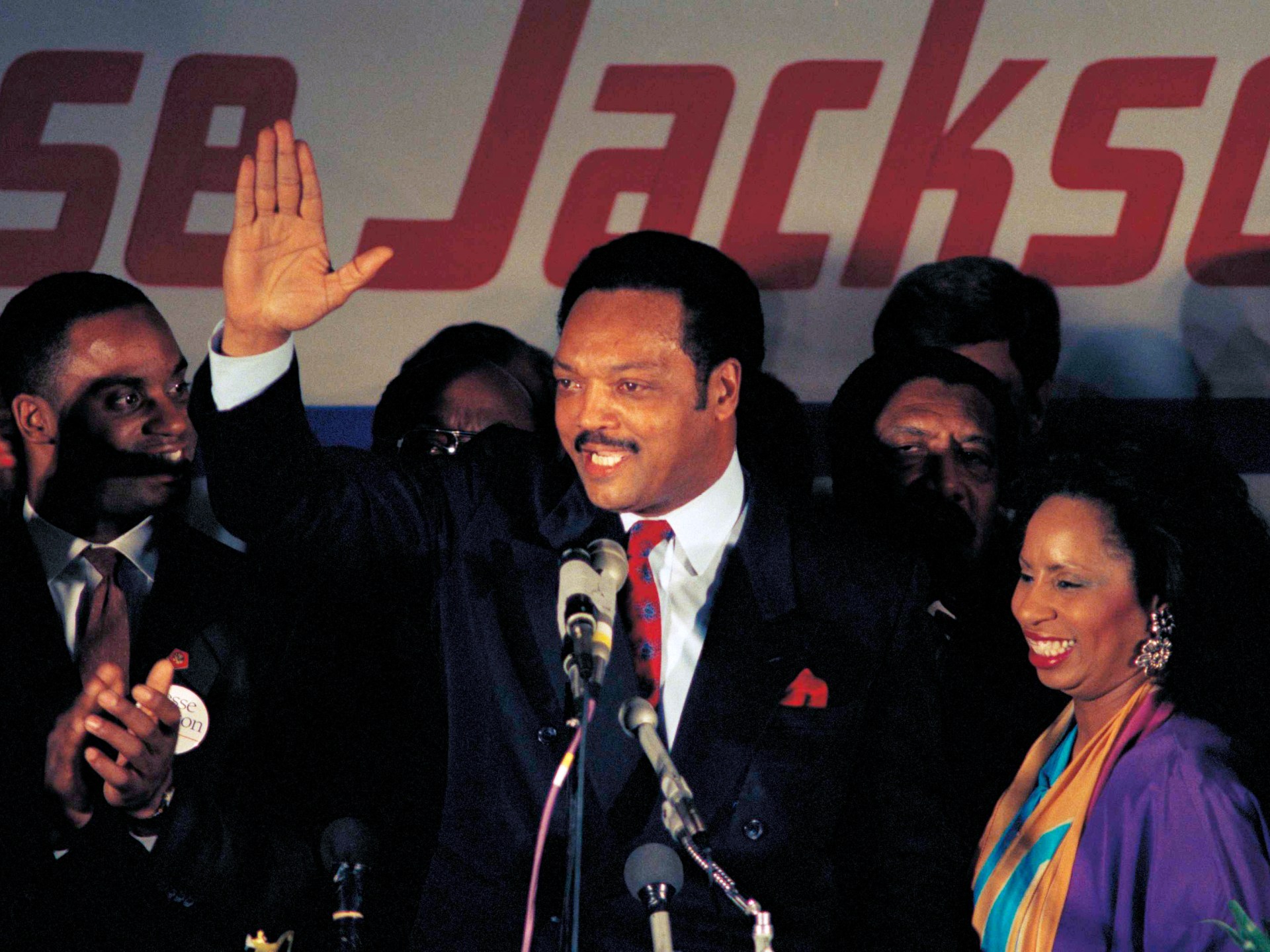

Washington, DC – More than 40 years ago, United States civil rights leader Jesse Jackson called on the Democratic Party to open its doors and welcome “the desperate, the damned, the disinherited, the disrespected and the despised”.
This included Arab Americans and Palestinian rights supporters, who have suffered from decades of racism, demonisation and marginalisation.
- list 1 of 3US civil rights leader Jesse Jackson dies aged 84
- list 2 of 3Jesse Jackson, civil rights icon, dies at age 84
- list 3 of 3Tributes pour in after US civil rights icon Jesse Jackson dies at 84
end of list
Advocates in those communities say that Jackson, who died on Tuesday at the age of 84, helped elevate their voices over his decades-long career.
“I don’t think there’s a way to tell the Arab Americans’ political empowerment story without understanding the path that Reverend Jackson created for us,” said Maya Berry, executive director of the Arab American Institute (AAI).
In 1984, Jackson appointed Arab American activist James Zogby as one of his deputy campaign managers as he mounted a bid for the presidency. Zogby would later found the AAI.
Jackson’s campaign also actively courted Arab Americans and amplified calls for Palestinian self-determination in an era when unquestioning support for Israel was the default position in US politics.
Berry said Jackson always rejected pressure to disassociate from Arab Americans who view Palestine as a focal issue.
“He understood that the fight for justice was one that had to be done when it was both hard and easy. Our country has lost a giant,” she told Al Jazeera.
The party platform
Jackson launched a second campaign for president in 1988, winning 13 states, including Michigan and much of the South, in the Democratic primary.
Advertisement
He ultimately lost the nomination to then-Massachusetts Governor Michael Dukakis. Still, Jackson’s campaign catapulted Palestinian rights into the national discourse.
Zogby and other Jackson delegates at the Democratic National Convention rallied to include support for Palestinian statehood in the party’s platform that year.
While the push eventually fell short at the national level, 11 state parties adopted platforms expressing support for “the rights of the Palestinian people to safety, self-determination and an independent state”.
Jackson’s relative success in the primary also led to the appointment of an Arab-American activist, Texan Ruth Ann Skaff, to the Democratic National Committee (DNC), the party’s executive board.
At the time, Skaff faced unfounded accusations of anti-Semitism for her pro-Palestinian stance, not to mention calls to be removed from the committee.
But in an interview with Al Jazeera, she said she was just a local organiser from Houston, Texas, not a high-level political operative.
She explained that Jackson’s embrace of the Arab-American community rang “true to his message of wanting to empower those who do not have power or who are excluded”.
She also recalled him being humorous and approachable.
“We were learning how to organise, how to spread the message and then take it to the next step of being active politically at the very local level. And he guided us and inspired us the entire way,” Skaff said.
Born in South Carolina in 1941, under the racial segregation of the Jim Crow laws, Jackson was dedicated to civil rights from a young age.
He was considered a talented public speaker, and as a pre-teen, he became a protege of the civil rights icon Martin Luther King Jr.
A central part of his national platform was to stress the need for a broad coalition of communities to come together and demand equal rights.
Jackson moved to Chicago in 1965, where he founded the civil rights and community empowerment movement that became known as the Rainbow/PUSH Coalition.
Even after his presidential run, Jackson remained close with the Arab community.
Hatem Abudayyeh, the executive director of the Arab American Action Network (AAAN) in Illinois, praised Jackson as “a tried-and-true Chicagoan, one of us, who opened the doors to Rainbow/PUSH for Palestinians and Arabs in Chicagoland”.
“Under his leadership, Black, Latino, Asian, Arab and so many other communities worked together for racial, economic, and social justice,” Abudayyeh told Al Jazeera in a statement.
Advertisement
“He never shied away from solid and principled solidarity with our Palestinian and Arab communities,” he added. “We mourn today with our friends in the Black community, and with all those who will carry on his fight.”
Support for Gaza protesters
Nabih Ayad, the founder of the Arab American Civil Rights League (ACRL), said Jackson was one of the first leaders to shine light on the plight of Palestinians at the national stage.
He also worked on other issues related to the Arab community. In 2015, for instance, Jackson lobbied for the admission and resettlement of Syrian refugees, despite opposition from Republican governors.
The ACRL, based in the Michigan suburb of Dearborn, hosted Jackson on a panel to highlight the refugees’ plight. Ayad said Jackson’s message was that “justice is universal”.
“It was an honour to cross his path and be able to see a giant like Jesse Jackson really caring about the little people, the small guys, about injustice wherever it happens, no matter where it is around the world,” Ayad told Al Jazeera.
This drive to address injustice drove Jackson to speak up for Palestinians even when it may have cost him politically, according to Ayad.
Jackson’s Rainbow/PUSH Coalition organised an emergency summit in 2024 to call for a ceasefire during Israel’s genocidal war on Gaza.
Later that year, he voiced support for pro-Palestine protests on college campuses, writing in the University of Chicago’s newspaper, The Chicago Maroon, that the student leaders “represent the best of our nation”.
Matthew Jaber Stiffler, the director of the Center for Arab Narratives, a research institution, said Jackson helped the Arab community feel “seen”. He, too, highlighted the political costs of championing Palestinian rights.
“Even just saying, ‘I support the rights for Palestinians to exist in the national political sphere,’ could get you branded as a radical, could get you pushed to the margins,” Stiffler told Al Jazeera.
“Mainstream candidates didn’t – and still don’t – really want that plank in their platform. And I think that’s why there was such love for Jesse Jackson and what he stood for, because he was not afraid.”
‘Work that has to be done’
In the decades since Jackson’s presidential campaigns, Palestine has become less of a taboo subject in US politics. Congress members, mayors and celebrities have become vocal in criticising Israeli abuses.
Still, the leadership of the Democratic and Republican parties have avoided publicly supporting Palestinian rights. During the 2024 presidential race, for instance, both major parties adopted staunchly pro-Israel platforms.
The campaign of Democratic presidential nominee Kamala Harris even refused to allow a Palestinian speaker at the party’s convention that year.
The flow of US money and weapons to Israel has also continued uninterrupted, despite the horrific atrocities in Gaza.
Furthermore, since taking office in January 2025, the administration of President Donald Trump has led a crackdown on Palestinian rights advocates, threatening foreign-born activists with deportation and other penalties.
Advertisement
Berry said that while the current conditions are challenging, Jackson taught the community to overcome barriers and build its power.
“I think that the lessons and the legacy of someone like Reverend Jackson teaches us that this is work that has to be done,” she told Al Jazeera.
For her part, Skaff said Jackson wanted Arab Americans to stand up and let their message be known.
“We’re stronger when we’re united and when we exercise our rights and responsibilities as American citizens: to stand up, to speak out, to run for office, to vote, vote, vote, vote,” she told Al Jazeera.
Related News

Japan’s Takaichi vows to deliver on tax cuts after LDP’s ‘historic’ win

Kremlin official says Russian navy to stop West’s seizure of merchant ships
Cambodian PM says Thailand occupying ‘deep’ territory after ceasefire