

Senior Reporter
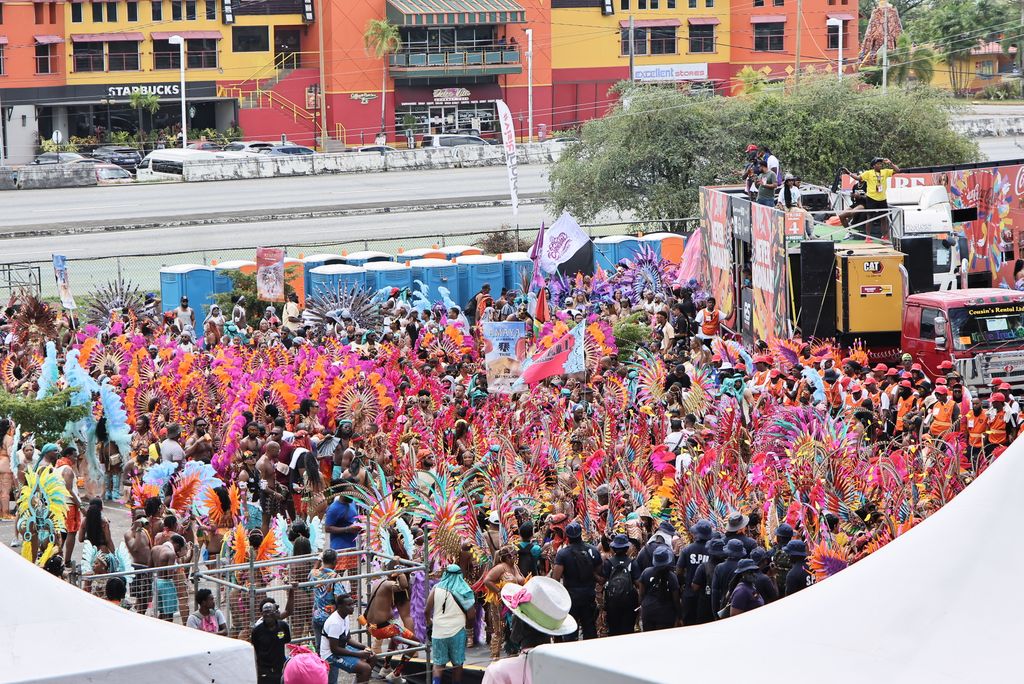
Prime Minister Kamla Persad-Bissessar is calling on masqueraders to refrain from doing anything to embarrass or humiliate themselves or their loved ones while enjoying the Carnival revelry. Her comment came amidst calls by Archbishop Jason Gordon for the Government to regulate the festivities.
Guardian Media asked the Prime Minister yesterday to weigh in on the controversy surrounding the distribution of adult toys by mas band Tribe in their goodie bags to female masqueraders this Carnival.
On Sunday, the Roman Catholic Archbishop, in his homily, condemned the move. He said if Carnival continues to slip into this type of “hedonism,” the Government should step in and regulate, particularly Carnival Monday and Tuesday, if mas bands fail to do so.
In a WhatsApp response on the issue, Prime Minister Persad-Bissessar offered some words of advice, urging masqueraders not to embarrass themselves or their families.
“My advice to Carnival revellers is to enjoy yourselves, but don’t do anything to embarrass yourself or demean your loved one’s reputations. I wouldn’t want to see anyone who was really just trying to have a good time being humiliated on social media because of a regrettable act they committed in a moment of bad or impaired judgement.” The Prime Minister did not address the call for the Government to regulate the festival.
But president of the Trinidad and Tobago Carnival Bands Association (TTCBA), Mark Ayen, said any move to regulate mas or mas bands must begin with consultation with the stakeholders. Ayen said he hopes his organisation is contacted before anything is implemented.
“When we speak about our culture, our culture is a manifestation of our people, a representation of our people. So, what I would say is that consultation is required before any decision is made where our culture and our Carnival are concerned. And I do ask and will mandate that the relevant stakeholders are involved in that conversation before any decision is made,” he said.
Culture Minister Michelle Benjamin said she could not immediately comment and wanted to respond in writing to the questions raised in relation to calls for the Government to regulate Carnival.
When contacted, Tribe Group CEO Dean Ackin said he had no comment.
But for Ayen, the distribution of the sex toy is just a continuation of Tribe as a private entity, doing as it sees fit. He added that “many years ago”, the band distributed condoms with not as much pushback.
“So, are they promoting safe sex? Is that what it is? So again, it’s always how you look at it, you look at the cup half empty or half full.”
In a post in the Catholic News, Father Robert Christo penned an article entitled “Is Carnival for Sale”.
Christo said the Church is not against Carnival, but what he said was overconsumption. Christo said there is a love for Carnival, not just by the Archbishop but also by the Catholic Church.
“The Church is not anti-Carnival. We are a people of Resurrection joy. But joy turns into idolatry when freedom mutates into exploitation, when creativity becomes commodity, illicit sex acts replace sacred sexuality and when the poor disappear from the streets they built with their sweat. The prophets always asked the same piercing question: Where is the poor? If the answer is ‘outside the ropes’, then something holy is being stolen.”
He said the festival, born on Piccadilly Street and in Laventille yards, has a soul, which was shaped by “the breath of the small man, the drum of the poor, the craft of the creative, and the joy of a people.”
“But today the ground beneath us has shifted. A new tribe has risen, not of culture but of capital. A tiny circle of money-hungry moguls, a mafia-like oligopoly, now holds the reins of the fête economy and dictates the face of celebration in Trinidad and Tobago. What once belonged to the many has been captured by the few.”
His comments echoed the Archbishop’s, who blamed a few band leaders for the supposed moral decay of Carnival. Christo said there is a “small cluster of promoters” gatekeeping access and denying anything and anyone they deem unfit to match their band.
“Meanwhile, the orange vendor who once stood by the gate, the snow cone man who sweetened the night, the bottle collector hustling with purpose, the small rum shop feeding a corner crew, the young hustler with a cooler, the pan around the neck side raising funds under the streetlight, all find themselves priced out, fenced out, or regulated out of spaces they helped to build. The cruel irony is that we are paying the moguls for the privilege of feeling included.”
Touching on what he called the hedonistic turn of Carnival, Christo wrote that the country is viewing a troubling exchange where hedonism is overshadowing heritage and elitism replacing inclusivity.
“Consumption is swallowing creativity, fashion outshining folklore, commercialisation erasing community, and sexual spectacle distorting a God-given sexuality. When a fête becomes a marketplace of bodies, wanton greed, and alcohol rather than a celebration of beauty, resilience, community, history and belonging, something sacred is lost.”
Christo said Carnival is now at a crossroads and the questions must be asked: who is benefiting, what is being celebrated, who is being pushed out and who we are becoming.
He said Carnival Monday and Tuesday have been quietly captured by “the same mafia-like moguls” who are curating an “ultimate experience” which he said felt more like controlled consumer events than people’s mas.
“The pure brand of Carnival’s authenticity is fading as the old freedom of Monday wear gives way to a narrow, branded road experience managed by a few and paid for by the many.”
He said the way Carnival is marketed now seems gluttonous.
“You smell the mountain of wasted food. You hear music so loud it drowns the possibility of real conversation. You taste the pressure to over-consume simply because the price was high. You touch the velvet ropes and guarded entrances designed to separate people. You see a hypersexualised image of freedom that feels more curated than cultural. Everything is louder, pricier, and more extravagant, yet strangely emptier.”
He quoted US Bishop Robert Barron, who said when pleasure replaces purpose, the soul shrinks. He added that the Church’s theology of the body is a reminder that the human body is sacred and is made not for consumption but for communion and relationship.
He said a rebellion is rising in the form of Patrice Roberts’ free giveback concert and a “pay-what-you-can” mas band by Berkeley Carnival Revolution. This, Christo said, was a form of pushing a different kind of inclusivity.
“These movements whisper that the people are tired of being priced out of the festival they created.”
Related News
Socadrome Village returns to Jean Pierre Complex for Carnival 2026

Relatives uneasy over police presence at Samaroo funeral

100 employees displaced after multimillion dollar fire