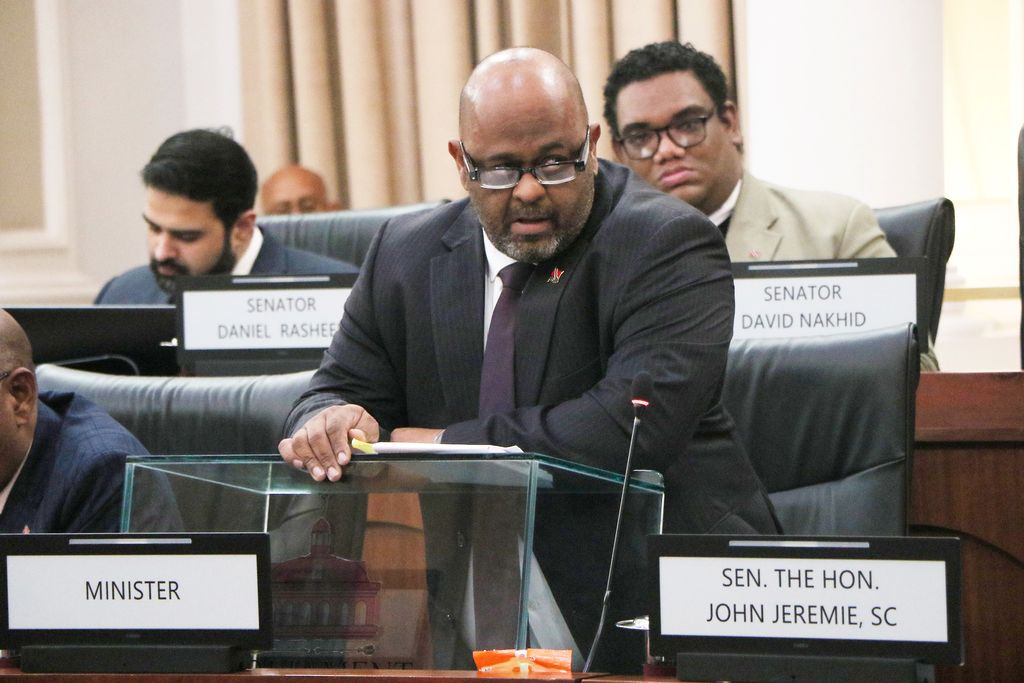

Despite calls from the Opposition for broader consultation, the Government says it is moving ahead with amendments to the Bail Act, insisting the changes are necessary to protect the integrity of the criminal justice system.
Defence Minister Wayne Sturge yesterday made it clear there would be no consultations with the Law Association and no referral of the bill to a Joint Select Committee.
Sturge told the Senate the amendments are aimed at fixing what he described as a dangerous loophole created by the 2024 Bail Amendment Act, one he said has allowed accused murderers to apply for bail without proving exceptional circumstances.
He said the gap in the law had triggered a surge in bail applications and produced conflicting judicial interpretations, undermining consistency in the administration of justice.
The minister rejected Opposition calls for further scrutiny, arguing the legislation was straightforward and technical in nature.
“So, no, we did not consult the Law Association, and no, we do not intend to in the very near future ... There’s no need for a Joint Select Committee on basic legislation. And in any event, should Senator Boodhu (temporary opposition senator Sanjiv Boodhu) raise it, let me say it in advance, you don’t invite judges to sit on parliamentary committees because they’ll have to pronounce upon the very thing that they were a party to.”
The bill, on its second reading in the Senate, seeks to harmonise the standards governing liberty in capital cases, while also expanding the powers of judicial officers to interrogate the source of bail funds.
At the centre of the proposed changes is a bid to correct what Sturge described as a “lacuna” in Section 5 of the Act, which emerged after the 2024 amendments. Under the current framework, persons charged with murder are generally required to demonstrate “exceptional circumstances” to qualify for bail. However, the Government argues that Section 5(5) created an unintended second regime, allowing accused people to apply for bail if evidence was not taken within 180 days, or if a trial was not completed within one year, without expressly linking that application to the exceptional circumstances test.
Clause 4 of the new bill seeks to eliminate that inconsistency, ensuring that the higher threshold for bail in murder cases applies uniformly, regardless of trial delays.
Beyond procedural reform, the legislation also targets the financial practices of organised crime. Under the bill, courts would be required to conduct a bail source hearing in any case where an accused person or surety seeks to post $30,000 or more in cash, or presents a certified copy of a deed as security.
Sturge argued that the current system is being exploited to “launder the proceeds of illicit activity,” particularly by organised criminal networks. He warned that gang leaders often use large sums of cash, not derived from legitimate labour, to secure bail, reducing the incentive to comply with court conditions.
He said that when such accused persons are later acquitted or killed, the return of bail funds effectively injects “cleaned” criminal money back into the economy.
To address this, the bill extends the authority to scrutinise the source of bail funds beyond High Court judges to include masters and magistrates.
Acknowledging concerns about privacy and personal safety, the bill introduces a statutory duty of confidentiality for court staff and judicial officers. Bail source hearings may be held in-camera, with strict penalties ranging from $50,000-$100,000 in fines and imprisonment.
“To deal with the privacy concerns, the fact that we have created this offence and the punishment is harsh, that in essence establishes a legitimate aim. It establishes the test of proportionality. It’s justified, it’s necessary so that persons within the criminal justice system would think twice about exposing persons’ financial information,” Sturge said.
However, Opposition Senator Faris Al-Rawi rejected Government’s proposals, describing key provisions of the bill as poorly drafted and constitutionally risky.
“The law is so badly drafted before us. The minister has come to post bail, cash over $30,000 when the law conflicts and says it must be under $10,000; not amending that section, so you’re going into confusion on implied repeal,” he said.
“So condescending to the Opposition and to other persons in the opposition, including the Law Association. We must just take it at face value. No sir, that is not the way law operates.”
Al-Rawi warned that sensitive financial information could still enter the public domain once judgments are published, despite provisions for in-camera hearings, and said the Opposition intends to bring amendments to address what he described as serious defects in the legislation.
Meanwhile, Independent Senator Anthony Vieira warned that while the bill pursues legitimate objectives, it risks undermining fundamental rights in practice.
He argued that delays in obtaining bank records, deeds, or valuations could result in bail being denied for reasons unrelated to public safety or flight risk.
“Bail may be denied not because the accused is dangerous, not because the accused is a flight risk, not because the prosecution has shown just cause, but because they could not assemble paperwork quickly enough. This is a serious constitutional concern,” he said.
He warned the measures would have little impact on the wealthy, while further marginalising the poor.