
DAREECE POLO
Senior Reporter
dareece.po[email protected]
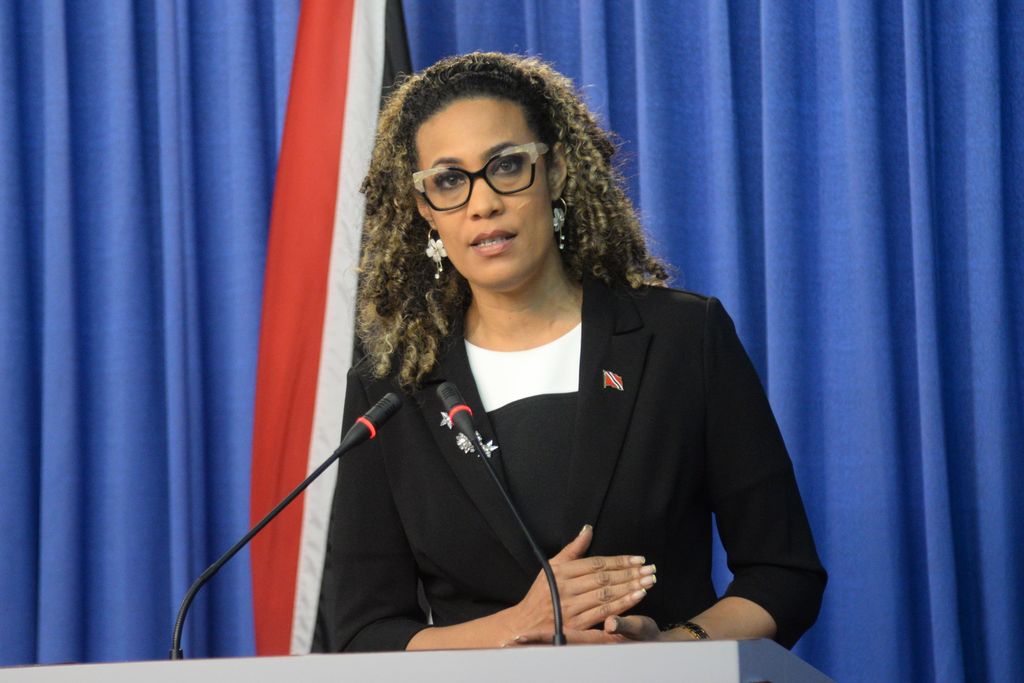
Rural Development and Local Government Minister Khadijah Ameen has again pushed back against what she described as “mischievous comments” by Opposition Leader Pennelope Beckles over the Government’s decision to establish a committee to review the boundaries of municipal corporations in Trinidad.
She was speaking at the post-Cabinet media conference at the Diplomatic Centre on Thursday.
Ameen rejected Beckles’ claims as misleading, saying they reflect a fundamental misunderstanding of the parliamentary process, the scope of legislation governing local government and the role of the Elections and Boundaries Commission (EBC).
“I want to make it very clear that the Cabinet-appointed committee to review the boundaries of municipalities is not a UNC committee. It is also not chaired by any minister. It is a Cabinet-appointed committee led by a retired and very competent former public servant, the former director of planning at the Town and Country Planning and a former acting permanent secretary in the ministry of the then local government.”
She strongly defended the chair of the committee, stressing that the review process is technocratic, not political.
“The chairperson of this committee is a technocrat with decades of professional experience and a person who does not have any political affiliation. So this is not a political committee in any way. And I think it is really irresponsible for the leader of the Opposition to suggest otherwise and to present what is a technocratic review process as something partisan. It is not. And I think such statements really undermine public confidence, but it distorts facts.”
On November 28, 2025, the Ministry of Rural Development and Local Government announced that instruments of appointment had been issued to the committee for the Review of Municipal Boundaries in Trinidad.
The committee is chaired by Stara Ramlogan and includes members Feroz Khan, Sabrina Mowlah Baksh, Christlyn Moore, Dr Assad Mohammed, Dr Allen Sammy, Vijay Gosyne, Cornelius Price, Lennox Sankersingh, Peter Kanhai and Denish Sankersingh.
Ameen said the boundaries of municipal corporations are determined by an Act of Parliament, recalling that legislation passed in 1990, and subsequently amended, replaced county councils with municipal corporations. She said this framework clearly distinguishes between municipal boundaries, which fall under Parliament, and electoral boundaries, which are the responsibility of the Elections and Boundaries Commission (EBC).
“So, there is no question about the validity of such a committee. And I want to tell you, the committee is not making the changes. The committee will look at the data, they will look at growth polls, and they will look at concentrations in terms of not just population but amenities. They will look at areas that have commercial centres and schools and a concentration of other activities, and they will analyse and make recommendations. It is up to the Cabinet and then the Parliament to accept these recommendations.”
She added that the restructuring and resizing of municipal corporations has been under discussion for decades, and is not a new or partisan issue.
Ameen recalled that senior PNM figures had previously gone on record arguing that Tunapuna/Piarco, with a population nearing a quarter of a million people, should be divided into a Tunapuna borough and a Piarco region.
She also pointed to changes made under a previous PNM administration, when the Diego Martin and Siparia regional corporations were redesignated as boroughs.
“That is not the creation of a borough. A borough really has to be a centralised area of commercial and other activity, a developmental focus of the government and of the local authority. So the PNM would have failed in terms of the true creation of a borough. And what we are doing now will allow us to review and look at the data and let the committee make their recommendations.”
Ameen said there is now a clear imbalance in local government, with some municipalities serving populations as large as 250,000, while others have as few as 17,000 to 20,000 residents, creating funding and service delivery challenges.
“The disparity in funding has always been a hot topic,” she said.
She accused the Opposition of politicising an issue that requires bipartisan maturity.
“You can’t play politics with local government because local government is so close to the ground. Both PNM and UNC persons have advocated for these changes, and I don’t know if Ms Beckles consulted with her members before she made such a statement, but the changes have to be done.”
Ameen said the committee has already adopted a structured consultative approach, engaging technical officers within municipal corporations, ministries and other key stakeholders.
She added that opposition-led municipal corporations will be part of the consultation process and will have the opportunity to provide input.
Beckles, earlier this week, accused the Government of attempting to gerrymander electoral boundaries ahead of the next local government elections.
In a statement, she described the Cabinet-appointed committee as a “clear and present threat to democracy” and a “thinly veiled attempt” to interfere with the electoral process.
She argued that the initiative encroaches on the constitutional remit of the EBC and warned of political manipulation designed to entrench the ruling party.
Beckles also claimed that a committee appointed by the Cabinet and allegedly led by a government minister could not credibly claim neutrality.
“The integrity of our electoral system must be defended,” Beckles said.
Ameen rejected those assertions outright, insisting the review is lawful, long overdue and driven by data rather than politics.