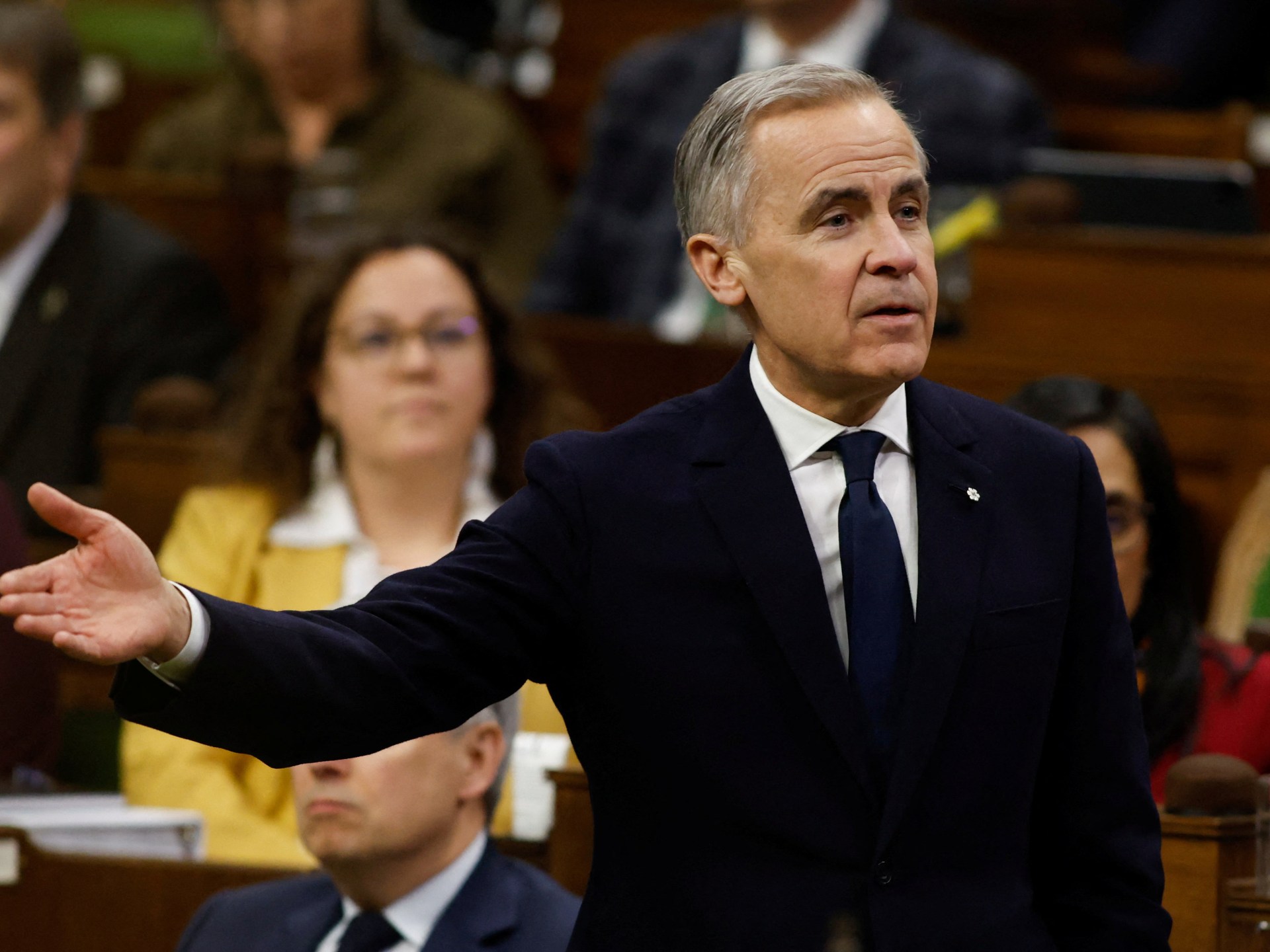

Canada’s Prime Minister Mark Carney has said that he expects the United States to respect the country’s sovereignty after reports that Alberta separatists have met several times with officials of the Donald Trump administration.
The Financial Times reported that US State Department officials held meetings with the Alberta Prosperity Project (APP), a group calling for a referendum on whether the energy-rich western province should leave Canada.
end of list
Speaking in Ottawa on Thursday, Carney said he has been clear with US President Donald Trump on the issue.
“I expect the US administration to respect Canadian sovereignty,” he said, adding that after raising the issue, he wanted the two sides to focus on areas where they can work together.
Carney is himself an Albertan, raised in Edmonton, the provincial capital. The province has had an independence movement for decades.
Trump has repeatedly threatened to make Canada the “51st state” of the American Union.
Here is what we know:
Leaders of the APP have reportedly met with US State Department officials in Washington at least three times since last April. Trump entered office for a second time in January.
These meetings have prompted concern in Ottawa regarding potential US interference in Canadian domestic politics.
This follows comments by US Treasury Secretary Scott Bessent last week, who described Alberta as “a natural partner for the US” and praised the province’s resource wealth and “independent” character during an interview with the right-wing broadcaster Real America’s Voice.
Advertisement
“Alberta has a wealth of natural resources, but they [the Canadian government] won’t let them build a pipeline to the Pacific,” he said. “I think we should let them come down into the US,” Bessent said during an interview with the right-wing broadcaster.
“There’s a rumour they may have a referendum on whether they want to stay in Canada or not.”
Asked if he knew something about the separation effort, Bessent said, “People are talking. People want sovereignty. They want what the US has got.”
After Bessent’s comments, Jeffrey Rath, a leader of the APP, said that the group was seeking another meeting with US officials next month, where they are expected to ask about a possible $500bn credit line to support Alberta if a future independence referendum – which has not yet been called – were to be held.
The developments come at a sensitive moment in US-Canada relations, with trade tensions still simmering and after a recent speech at the World Economic Forum in Davos where Carney warned that Washington was contributing to a “rupture” in the global order.
Trump has repeatedly threatened to make Canada part of the American Union. His expansionist ambitions have been further underscored by his recent push to acquire Greenland from Denmark, which, like Canada, is a NATO ally. At the start of the year, the US military also abducted Venezuelan President Nicolas Maduro, and has since attempted to take control of the South American nation’s massive oil industry.
How have Canadian leaders reacted to the reports?
Speaking on Thursday, British Columbia Premier David Eby described the reported behind-the-scenes meetings as “treason”.
“To go to a foreign country and to ask for assistance in breaking up Canada, there’s an old-fashioned word for that – and that word is treason,” Eby told reporters.
“It is completely inappropriate to seek to weaken Canada, to go and ask for assistance, to break up this country from a foreign power and – with respect – a president who has not been particularly respectful of Canada’s sovereignty.”
Ontario Premier Doug Ford appealed for Canadian unity on Thursday morning.
“You know, we have a referendum going on out in Alberta. The separatists in Quebec say they’re gonna call a referendum if they get elected. Like, folks, we need to stick together. It’s Team Canada. It’s nothing else,” he said.
Alberta Premier Danielle Smith, however, said she won’t demonise the Albertans who are open to separation because of “legitimate grievances” with Ottawa and said she did not want to “demonise or marginalise a million of my fellow citizens”.
Advertisement
Smith has long been pro-Trump and visited the US president’s Mar-a-Lago estate in January 2025, at a time when most other Canadian leaders were joining hands to criticise his demand that the country become a part of the United States.

Anger towards Ottawa has been building in Alberta for decades, rooted largely in disputes over how the federal government manages the province’s vast oil and gas resources.
Many Albertans feel federal policies – particularly environmental regulations, carbon pricing and pipeline approvals – limit Alberta’s ability to develop and export its energy.
As a landlocked province, Alberta depends on pipelines and cooperation with other provinces to access global markets, making those federal decisions especially contentious.
Many Albertans believe the province generates significant wealth while having limited influence over national decision-making. In 2024-25, for instance, it contributed 15 percent of Canada’s gross domestic product (GDP), despite being home to only 12 percent of the population.
Alberta consistently produces more than 80 percent of Canada’s oil and 60 percent of the country’s natural gas.
Yet, many Albertans say that the federal government does not give the province its fair share from taxes collected. Canada has a system of equalisation payments, under which the federal government pays poorer provinces extra funds to ensure that they can maintain social services. While Quebec and Manitoba receive the highest payments, Alberta – as well as British Columbia and Saskatchewan – at the moment receive no equalisation payments.

Carney recently signed an agreement with Alberta, opening the door for an oil pipeline to the Pacific, though it is opposed by Eby and faces significant hurdles.
Recent Ipsos polling suggests that about three in 10 Albertans would support starting the process of leaving Canada.
But the survey also found that roughly one in five of those supporters viewed a vote to leave as largely symbolic – a way to signal political dissatisfaction rather than a firm desire for independence.
A referendum on Alberta independence could happen later this year if a group of residents can collect the nearly 178,000 signatures required to force a vote on the issue. But even if the referendum passes, Alberta would not be immediately independent.
Under the Clarity Act, the federal government would first have to determine whether the referendum question was clear and whether the result represented a clear majority. Only then would negotiations begin, covering issues such as the division of assets and debt, borders and Indigenous rights.
What is the Alberta Prosperity Project and what does it want?
It argues that the province would be better off controlling its own resources, taxes and policies, and has been working to gather signatures under Alberta’s citizen-initiative rules to trigger a vote.
Advertisement
While it describes itself as an educational, non-partisan project, the group has drawn controversy over its claims about the economic viability of an independent Alberta.
On its website, the APP says, “Alberta sovereignty, in the context of its relationship with Canada, refers to the aspiration for Alberta to gain greater autonomy and control over provincial areas of responsibility.”
“However, a combination of economic, political, cultural and human rights factors … has resulted in many Albertans defining ‘Alberta sovereignty’ to mean Alberta becoming an independent country and taking control of all matters that fall within the jurisdiction of an independent nation,” it adds.
What else has Washington said?
White House and State Department officials told the FT that administration officials regularly meet with civil society groups and that no support or commitments were conveyed.
A report published by Canada’s public broadcaster CBC earlier this year quoted US national security analyst Brandon Weichert as saying that Trump’s talk of Canada becoming the “51st state” was, in reality, aimed at Alberta.
Appearing on a show hosted by former Trump chief strategist Steve Bannon, Weichert suggested that a vote for independence in Alberta would prompt the US to recognise the province and guide it towards becoming a US state.
Has the Trump administration tried this elsewhere?
Yes, in Greenland.
As with Canada, Trump has repeatedly called for Greenland to be incorporated into the US. His threats to annex Greenland have prompted strong opposition from the government of the Arctic island, Denmark — which governs Greenland — and Europe.
But as with Alberta, Trump’s administration has also attempted to test separatist sentiment. In August 2025, the Danish government summoned the top US diplomat in Copenhagen after Denmark’s national broadcaster reported that three Trump allies had begun pulling together a list of Greenlanders supportive of the US president’s efforts to get it to join the United States.
Related News
Israel bulldozes UNRWA buildings in occupied East Jerusalem
Will the Board of Peace live up to its name?

Iran delegates import powers as US war threats keep economy unstable