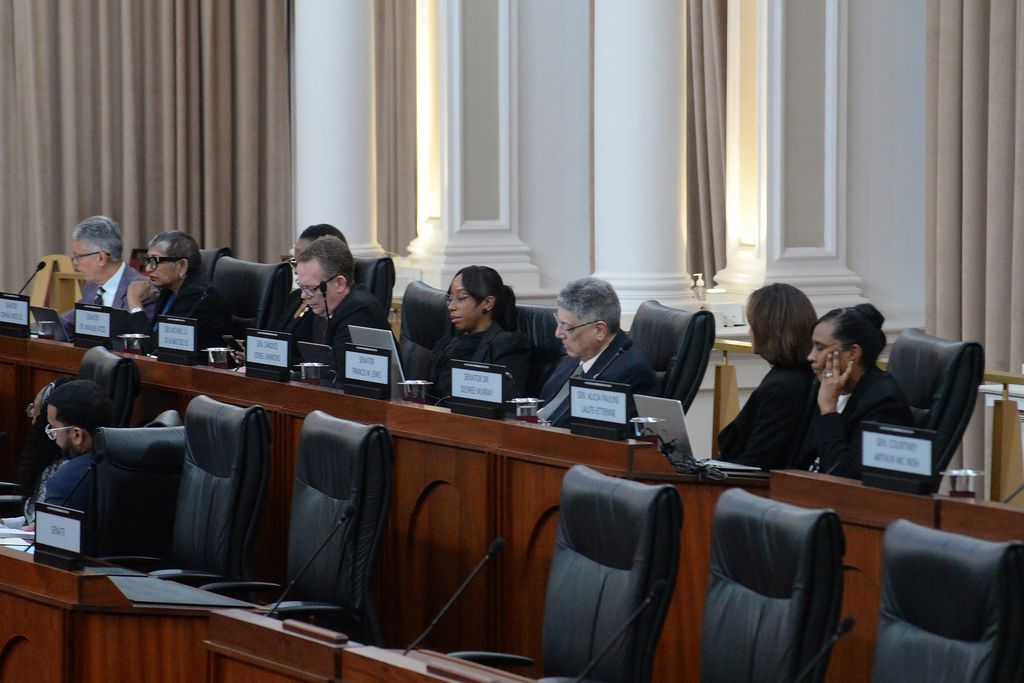

The Government’s outright refusal to consider amendments to the Zone of Special Operations (ZOSO) Bill has been cited by independent senators as the key factor behind their decision not to support the legislation in the Upper House on Tuesday.
The Government, which needed support from at least four independent senators, did not receive a single vote in their favour on the contentious Law Reform (Zones of Special Operations) (Special Security and Community Development Measures) Bill, 2026.
Eight of the independents voted against, with Senator Courtney Mc Nish abstaining.
In a statement yesterday, Independent Senator Anthony Vieira said his difficulty was not with the principle of the bill but with how the bill was drafted.
While he said voting against the bill was not an easy decision, he maintained it was the right one. He said several amendments were proposed in good faith and after careful research and serious constitutional analysis.
“These amendments were aimed at strengthening the bill, narrowing the constitutional override, clarifying objective criteria for declaring Zones, strengthening civilian and parliamentary oversight, safeguarding the constitutional role of the President as Commander-in-Chief of the armed forces, and ensuring that military personnel exercising police powers are properly trained and certified. These were not frivolous suggestions,” Vieira said.
He added, “They were principled, practical, and designed to make the legislation more robust, more defensible, and more likely to succeed in practice. Regrettably, many of these concerns were largely unheeded.”
On Tuesday night, after Attorney General John Jeremie said Government would not be making any amendments to the bill, Vieira expressed his disappointment with that decision. He said during the contribution a week earlier by Defence Minister Wayne Sturge, he was under the impression that amendments would be entertained.
On January 21, while speaking in the Upper House, Sturge acknowledged a recommendation from the Independent bench for there to be a sunset clause or expiration date built into the law.
At the time, Sturge said, “Based on what has turned up, when the committee sits and examines the operation of the ZOSO operations, a decision can be taken.”
Independent Sophia Chote told Guardian Media there were many reasons why she rejected the bill.
Asked if the Government’s refusal to entertain a sunset clause was a contributing factor, Chote said, “I found that a little confusing because I thought that when Minister Sturge had spoken, and I checked the Hansard myself yesterday, that he seemed to suggest that the Government was open to having a sunset clause put in. And that tends to be the case whenever you have legislation which is draconian, as this would have been. They had it for the anti-gang legislation, for example. So, I didn’t see that as being something that was terribly controversial to have included.”
Chote said she was also disappointed the AG signalled that Government would not be making any changes to the bill.
“I can’t speak for others, but I certainly feel that if, as legislators, we are being called upon to decide on whether a bill is going to move forward or not, as far as I’m concerned, from my perspective, I would want it to be the best bill possible or the best act possible that we can make. And I think certainly, every effort should be made to ensure that what we provide for the citizens of Trinidad and Tobago will be quality legislation. One of Senator Vieira’s proposed amendments, which I thought was actually quite good, was one which would have protected any prime minister from a plethora of legislative challenges if the power was used.”
Meanwhile, Senator Courtney Mc Nish, the lone abstention during the vote, gave his rationale for taking that position.
Mc Nish said, “I could not, in good conscience, vote ‘No’ and signal a rejection of the fight against crime. Nor could I vote ‘Yes’ and endorse a bill that I believe requires critical refinement to be effective and just.”
He added, “My abstention is a call to the Government to return to the table, refine the legislative gaps identified, and bring back a bill that is not only tough on crime but sound in law. I stand ready to support a perfected version of this bill.”
Despite this, he said he fully supports the intention of the legislation.
“However, as an Independent Senator, my primary obligation is to the Constitution and the long-term stability of our legal framework. We are here to make good law, not just fast law.”
Some of the proposed amendments put forward by Independent Senators
Senator Anthony Vieira called for the bill to clearly specify which constitutional rights under Sections 4 and 5 would be limited and why. He proposed an amendment to narrow and define any rights to be overridden, noting those sections protect fundamental freedoms, including freedom of movement, equality before the law, and protection from cruel punishment.
Senator Anthony Vieira called for Clause 6 to clearly define what constitutes “rampant criminality,” which is the threshold for declaring a Zone of Special Operations.
Senator Vieira called for Defence Force personnel who are to patrol the ZOSOs to be given approved law enforcement training with certification by the Commissioner of Police.
Senator Vieira called for an amendment to protect the Prime Minister against judicial review by requiring decision-makers to consider whether less intrusive measures outside of locking down a community are available and proportional to the threat.
Senator Dr Desiree Murray asked that Clause 22 of the bill be amended so police in the ZOSOs are mandated to wear body cameras. The bill says the cameras would be worn once available.
Senator Francis Lewis, in a previous sitting, asked for a Sunset Clause to be inserted into the legislation.
Senator Anthony Vieira called for more frequent early reviews and quarterly reporting on the effectiveness of the ZOSO.
Other Independent Senators withdrew their amendments after the AG signalled he would not be changing the bill.