
Senior Reporter
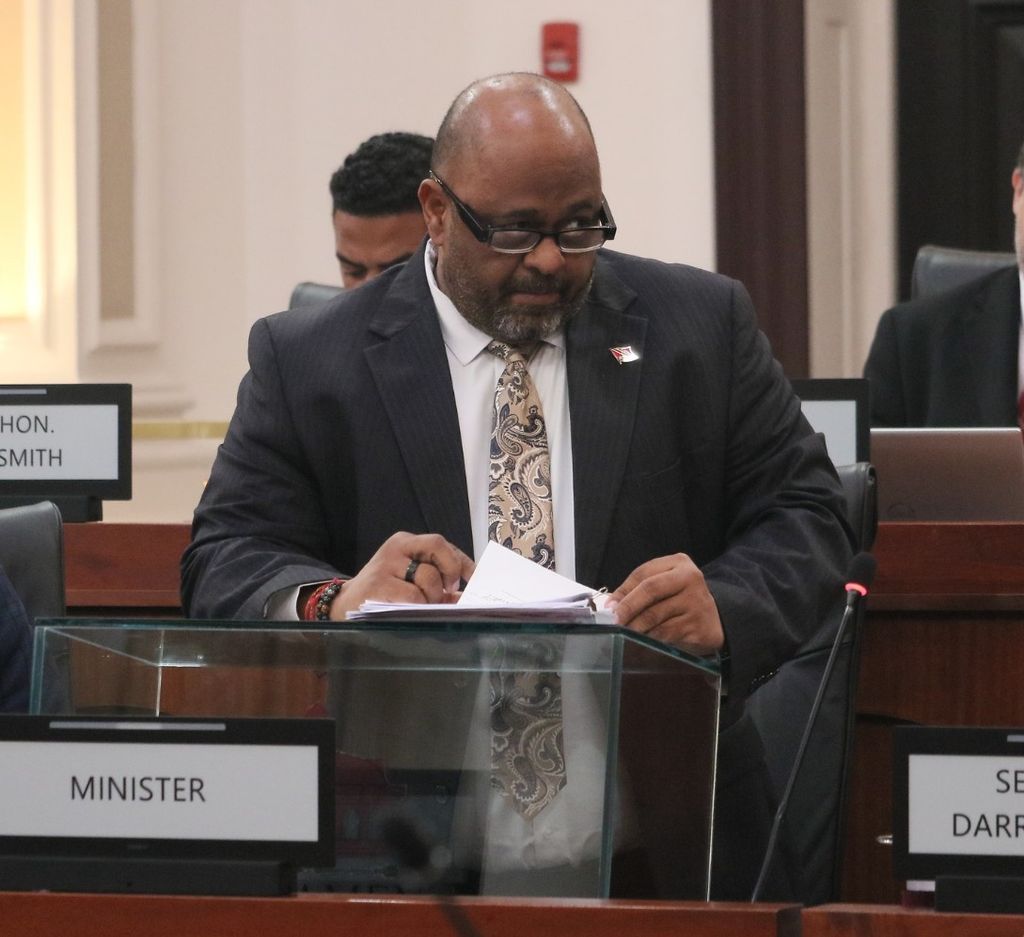
Opposition Leader Pennelope Beckles has criticised Defence Minister Wayne Sturge over comments suggesting that limiting constitutional rights is “a small price to pay” if the Government’s proposed Zones of Special Operations (ZOSO) legislation helps remove illegal firearms from communities.
Sturge made the remark during Wednesday’s Senate debate on law reform. In a statement to Guardian Media, Beckles said while the Opposition condemns violent crime and supports firm action against gangs and illegal weapons, crime-fighting must be done lawfully.
“The idea that constitutional rights are a ‘small price to pay’ for security is deeply dangerous,” Beckles said, stressing that rights are not optional privileges but the foundation of democracy and the rule of law.
She warned that public safety and constitutional protections must work hand in hand, not be set against each other.
Beckles described the minister’s comments as “reckless, disturbing, unconstitutional, and unbecoming” of someone sworn to uphold the Constitution. She said that fundamental rights are not expendable conveniences but safeguards against abuse of State power.
The Opposition Leader also questioned the Government’s record, noting that the country is currently under a State of Emergency—set to end on January 31—during which extraordinary powers have already been exercised.
She questioned what tangible results have been achieved in terms of sustained crime reduction and the dismantling of criminal networks.
The Opposition Leader expressed concern that the Law Reform (Zones of Special Operation) (Special Security and Community Development Measures) Bill could expand and normalise warrantless searches and arrests, concentrating these powers in specific communities—primarily those poor and marginalised. She said this would amount to “collective suspicion”, where one’s geography effectively determines guilt by association, and constitutional protections become conditional.
She rejected assurances that ordinary citizens have nothing to fear, saying that retrospective remedies, such as nominal damages, cannot substitute for constitutional protections before rights are violated.
On Wednesday, Prime Minister Kamla Persad-Bissessar took to social media platform X, where she criticised opponents of the Zones of Special Operations Bill.
“Over the past few days, during commentary on the Zones of Special Operations Bill, the country has witnessed a parade of weak men and women opposing the Bill, whose only apparent goal is the defence of violent criminals. It is astonishing how the PNM and pseudo ‘independent’ groups have suddenly discovered a manufactured sense of humanity to defend criminals and gangsters. They say nothing about the crime, robberies, rapes, murders, and brutal home invasions that have plagued the country for the past decade. They also remain silent on the dehumanising treatment endured by victims of crime.”
Rowley warns ZOSO bill risks abuse of power, division
Former prime minister Dr Keith Rowley also challenged Sturge’s defence of the proposed Zones of Special Operations (ZOSO) legislation, warning that the the Government risks courting abuse, resentment, and social division under the guise of fighting crime.
“If I had said anything nearly as offensive and arrogant as what Kamla recently said, everyone in this country would have known not to accept that from the Prime Minister,” Rowley said. “I am proud of that fact. It confirms to me that I was held to a higher standard, and I am satisfied that I met those standards.”
Responding to questions from Guardian Media yesterday, Rowley described the Government’s justification for the legislation as dangerous in Trinidad and Tobago’s already tense, multi-racial and multi-ethnic environment, arguing that it risks criminalising entire communities while stripping law-abiding citizens of entrenched rights.
“To stigmatise communities and removal of the entrenched rights of the law-abiding at the behest of officers without parliamentary oversight is not what one expects from a Government that is prepared to do its job of going after the lawbreakers without trampling on those who are law-abiding,” he said.
He warned that in a politically divided society, appeals to “fighting crime” may not be enough to contain the fallout once the law is enforced.
“Given the divisive politics and the suspicious nature of so many, it may very well turn out that the justification of ‘fighting crime’ might not be enough to manage the fallout when the law is applied,” Rowley cautioned, adding that “unsupervised authority will breed abuse and resentment and all that flows.”
During the Senate debate, Sturge insisted the bill is not intended to affect ordinary citizens, saying law-abiding residents would only be subject to action where there is reasonable suspicion or lawful grounds.
Scotland warns against sacrificing constitutional rights
Speaking with Guardian Media yesterday, Member of Parliament for Port-of-Spain South Keith Scotland contended that public safety and constitutional rights must go hand in hand.
“The idea that constitutional rights are a ‘small price to pay’ for security is deeply dangerous. Rights are not optional privileges; they are the foundation of democracy and the rule of law. While the State must confront violent crime, it cannot do so by weakening the very protections that safeguard ordinary citizens.”
Pastor Dottin urges broad consultation and careful adaptation
Seventh-Day Adventist pastor and former Police Service Commission member Clive Dottin said such assurances do not remove the need for broad consultation, particularly where constitutional rights are concerned.
“The issue of constitutional rights will always, and I want to repeat, will always trigger a lot of conversation,” Dottin said. While he supports the concept of Zones of Special Operations, he cautioned against importing the Jamaican model uncritically.
“What helped Jamaica is that it is not as plural as Trinidad, and the politics is different,” Dottin said. “In Trinidad, politics is primarily based on race, religion, colour and contrast. That is a fact.”
Dottin said the Government must engage institutions and the wider society before moving forward. “I still support the zone of special operations, but I think it would be important to deal with certain institutions in the country and have consultations on those rights that have to be suspended,” he said.
“Balancing Tough Policing with Human Rights”
Criminologist: Balance tough policing without violating rights
Criminologist Dr Randy Seepersad also weighed in, stating that while law enforcement must be empowered to deal decisively with heavily armed criminals, there is a clear danger in pushing enforcement beyond acceptable limits.
“There are things which are legal and well within the remit of law enforcement to deal with people with AK-47s,” Seepersad said, but warned that on that continuum, boundaries can be pushed to the point where human rights violations become unacceptable.
Dr Seepersad noted that while there are times when rights may be temporarily curtailed to address serious criminal threats, the overarching goal must be the protection of the wider population.
“Sometimes it becomes necessary to take a tougher stance to deal with the criminal element,” he said. “But it all depends on how far you’re willing to go.”
UWI lecturer: Watch closely for militarisation of policing
Meanwhile, Dr Maziki Thame, Senior Lecturer at the University of the West Indies, Mona, Jamaica, warned that ZOSOs and similar measures pose serious risks, particularly the gradual militarisation of policing.
Speaking on CNC3’s The Morning Brew, Dr Thame said Trinidadians should pay close attention to the direction law enforcement could take under such frameworks.
“I think that one of the things that Trinidadians should be aware of is the direction of policing, the militarisation of policing,” she said. Dr Thame noted that in Jamaica, Zones of Special Operations and States of Emergency place the Jamaica Defence Force directly into policing roles.
“There are certain risks associated with that, but there is also a way in which the police are becoming increasingly militarised themselves,” she said.
Dr Thame also challenged claims that ZOSOs automatically translate into safer communities, arguing that everyday community life is often severely disrupted.
“Community life is largely shut down in some communities,” she said. “So the very things that some of us would argue are the source of repair for communities that experience high violence are curtailed by these Zones of Special Operations, because effectively communities just cannot go about their business as normal.”
Addressing Jamaica’s recent decline in murder figures, Thame urged caution, noting that ZOSOs have been in place since around 2017 and that the reported drop in killings coincided with an increase in police shootings.
“The murders have reportedly declined last year, and it coincided with an uptick in police killings. I don’t think that that is coincidental,” she said, adding that much of the available data is based on police self-reporting.