
Lead Editor-Politics
akash.sama[email protected]
The Government’s proposed measure to ease the impact of the strict road traffic fines introduced at the start of the year moved a step closer to implementation yesterday, following the passage of the Motor Vehicles and Road Traffic (Amendment) Bill in the Lower House. The legislation comes after many penalties were doubled, sparking widespread public concern.
However, Opposition MPs have strongly criticised the Bill, describing it as absurd, impractical, and a knee-jerk response to public backlash.
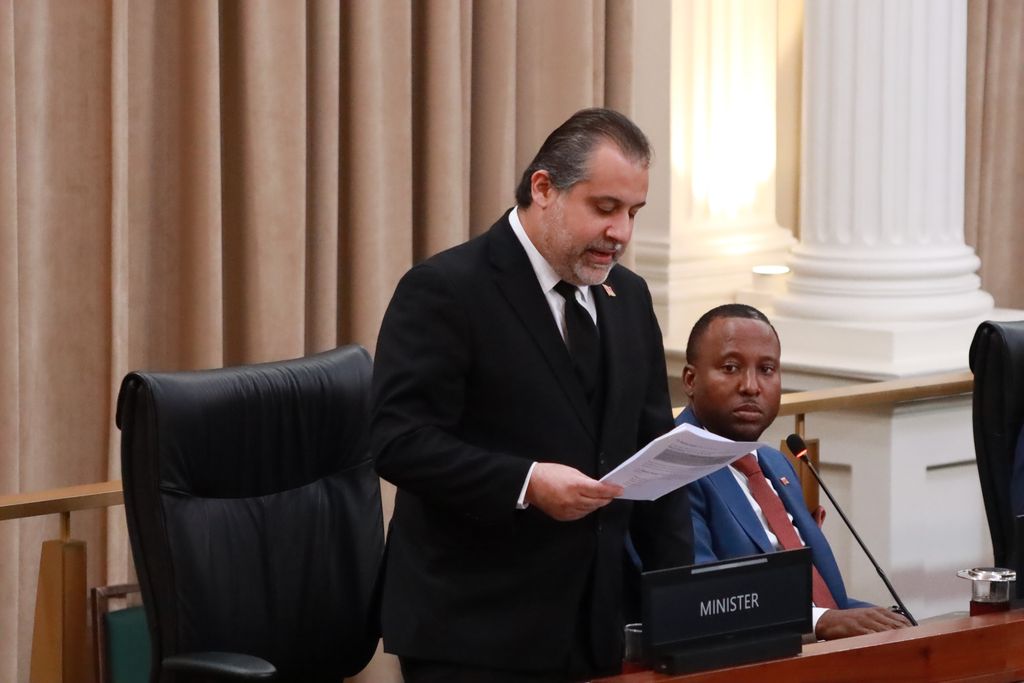
Debate commenced on The Motor Vehicles and Road Traffic (Amendment) Bill in the Lower House.
The primary goal of this bill is to shift from a “fine-first” approach to one that encourages compliance through warnings or a “grace period” for minor mechanical and administrative defects.
Transport and Civil Aviation Minister Eli Zakour said the legislation was expected to provide relief to motorists and the court system while improving relations between law enforcement officers and the motoring public.
Following the doubling of fines which came into effect with the passage of the Finance Bill, the Government received significant backlash from the public for what was seen as a clandestine revenue-generating initiative and a betrayal of the United National Congress’ campaign promise to lower the fines.
The Government argued that it was to combat rampant lawlessness on the nation’s roadways. But following the outcry, the Government sought to amend the bill.
Piloting the bill, Zakour said the existing legislation placed significant pressure on law enforcement agencies, members of the public and the courts, resulting in delays and administrative burdens.
He said they also found that law enforcement officers were inconsistent in exercising discretion.
“In the absence of a structured warning framework, two drivers committing the same violation may face different outcomes. If left unregulated, it risks undermining public confidence in law enforcement and may give rise to unfairness or discrimination, which are inconsistent with constitutional principles.”
Bringing data to the House, the minister added, “We have examined the data and note that in 2024 and 2025 a total of 27,554 fixed penalty notices were issued for the 18 specific traffic violations that have been identified for the six fixed penalty warnings in this amendment. Of that total, 14,887 fixed penalty notices were issued in 2024 and 12,667 were issued in 2025. In addition, there have been 1,414 documented warnings issued during 2024 and 1,091 documented warnings issued in 2025 to motorists in respect to traffic violations.”
The bill stipulates that instead of receiving an immediate ticket and fine, police officers and licensing officers are now required to issue a formal warning for 18 specific minor offences. Depending on the offence, drivers are given either three or seven days to fix the issue.
Explaining how the new law will work, Zakour said, “After doing so, the driver/owner is required to report to any police station, any office of the Licensing Authority or another location as specified in the warning and to produce evidence of compliance within the prescribed period. Upon satisfactory verification, the driver/owner will be issued a certificate of compliance. That certificate serves as confirmation that the requirements of a fixed penalty warning have been met and results in a driver or owner being discharged from any further liability in respect to the violation.”
However, Zakour said failure to fix the defect means the fixed penalty “warning” becomes a fixed penalty “notice” and the fine must be paid.
The minister said the use of warnings rather than immediate fines was more likely to foster positive interactions between motorists and law-enforcement officers.
He added that the approach also allows for discretion and leniency in cases where an infraction occurs moments before a driver is flagged by police.
Imbert: Amendment a “hypocritical” response to public backlash
But Opposition MP Colm Imbert said this wasn’t mercy by the Government but rather hypocrisy.
During the debate, Imbert said this amendment was in direct response to the backlash the Government got from doubling the traffic fines.
“The backlash was so powerful that I dare say that the majority of supporters of the UNC were outraged about this deception. And this is just an attempt to pacify those people who became so angry at this betrayal. So we need to put this bill into context. It follows the draconian increases in fines, and it is now an attempt to soften the blow of those terrible fines.”
Imbert said in the United Kingdom, people are given 14 days to rectify their issues. He said the three- to seven-day grace period was absurd, particularly from a law-enforcement perspective.
“This bill requires the person, the police officer, to report to the Licensing Office within 24 hours that they have affixed a notice to the windscreen of the errant driver. So this police officer who is out there on duty, on the road, and who has found that somebody has a defective tail light or something like that, has one day to notify the Licensing Office. How is he doing that in one day?”
The Diego Martin North-East MP added that motorists who drive foreign-used vehicles may not be able to source spare parts in under one week.
Meanwhile, Arouca/Lopinot MP Marvin Gonzales said licensing offices will not be able to deal with the volume of vehicles coming for certificates of compliance. He questioned why there is no provision for an extension for motorists to become compliant.
“It will cause more havoc and wreak more pain on citizens!” Gonzales said.
Motorists will be given a three-day grace period to correct offences including the absence of identification lights for licence plates, missing “Tare” or “MGW” markings on commercial vehicles, vehicles without a horn or silencer, missing reflecting mirrors, and excessive smoke or visible vapour emissions. A seven-day grace period will apply to defective fittings, including cracked or damaged windscreens, as well as noisy vehicles, particularly those with faulty mufflers or excessively loud exhaust systems.