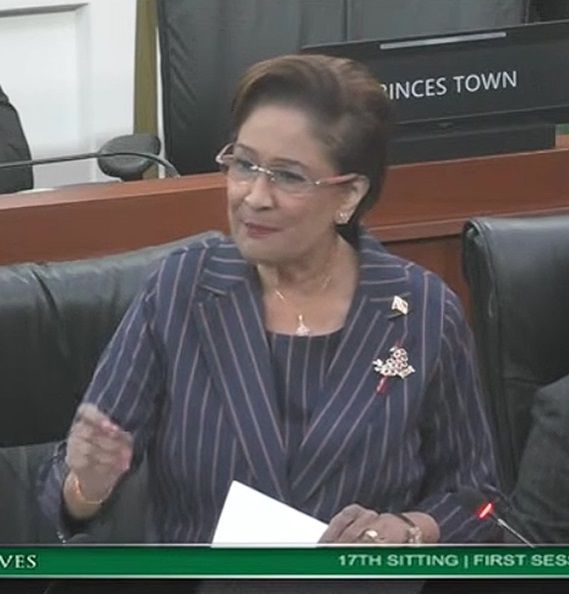

Prime Minister Kamla Persad-Bissessar says she makes no apologies for siding with the United States, as she defended her Government’s position on joint action against transnational organised crime.
During a lengthy address in Parliament she insisted no international law was breached during operations kinetic strikes in the Caribbean sea.
“And if you had some good lawyers on your side, we have some very good ones here including the Honourable Attorney General, they will tell you there was no international law that was breached when we were taking out, people were being taken out in their boats, trafficking, human trafficking, drugs, children,” Persad-Bissessar said.
“That is what we were doing, transnational crime. That is what we were fighting and we make no apology today.”
Persad-Bissessar said her administration remains focused on combating trafficking and other cross-border criminal activity and defended close cooperation with the US, which she described as Trinidad and Tobago’s oldest trading partner.
“My main focus against trafficking, against a transnational organised crime and today I make no apology for standing side by side, side by side with your oldest trading partner, the leader of the free world, in this hemisphere,” she said. “We make no apology today.”
Her comments echo remarks made earlier this week by Attorney General John Jeremie, who said advice he received confirmed that US strikes against alleged drug traffickers did not breach international law.
Speaking with the media at the United National Congress headquarters in Chaguanas, Jeremie said he sought external legal advice from an international expert.
“I have taken advice. The advice is that the strikes were consistent with international law. I took external advice, outside of the Office of the Attorney General, and that was the advice given to me by an international expert,” Jeremie said.
The issue arose following claims by UN High Commissioner for Human Rights Volker Türk in October last year that US attacks, which reportedly killed about 60 people, violated international law and warranted investigation.
The strikes included a September 2 attack that US Congress later scrutinised as a “double tap”, in which survivors of an initial drone strike were hit again as they attempted to flee.
Relatives of two Trinbagonians, Chad “Charpo” Joseph and Rishi Samaroo, have said they believe the men were killed during the airstrikes. Jeremie, however, said there is no evidence that any Trinidad and Tobago nationals were killed.
Related News

Health Ministry urges flu vaccination ahead of Carnival
Govt: T&T Embassy staff, nationals safe in Caracas
Venezuela’s new leader faces competing pressures from the U.S. and a government loyal to...