
Plane used in boat strike off Venezuela was painted to look like a civilian aircraft, AP sources say
 13 January 2026

The plane used by the U.S. military to strike a boat accused of smuggling drugs off the coast of Venezuela last fall was painted to look like a civilian aircraft, a move that appears to be at odds with the Pentagon’s manual on the laws of war.
The plane, part of a secret U.S. fleet used in surveillance operations, also was carrying munitions in the fuselage, rather than beneath the aircraft, raising questions about the extent to which the operation was disguised in ways that run contrary to military protocol.
Details of the plane’s appearance, first reported Monday by The New York Times, were confirmed by two people familiar with the situation who spoke on condition of anonymity to discuss the sensitive matter.
Pentagon Press Secretary Kingsley Wilson said in a statement that “the U.S. military utilizes a wide array of standard and nonstandard aircraft depending on mission requirements.”
The new details come after the Trump administration’s pressure campaign on Venezuela — which began with it massing military resources in Latin America and attacking a series of alleged drug-smuggling boats, killing at least 115 people — culminated this month in a stunning raid that captured Venezuelan President Nicolás Maduro. He and his wife were spirited to the United States to face federal drug trafficking charges.
Alarmed by the actions, the U.S. Senate is preparing to vote this week on a war powers resolution that would prohibit further military action in Venezuela without authorization from lawmakers.
Trump said to be trying to deter Republicans from war powers resolution
President Donald Trump has been so incensed over the Senate’s potential slap back on his war powers authority that he has been aggressively calling several Republican senators who joined the Democrats in voting to advance the resolution last week. It’s headed for a final vote as soon as Wednesday.
“He was very, very fired up,” said Senate Majority Leader John Thune, who did not vote for the resolution. He described Trump as “animated” on the subject when they spoke before last week’s vote.
In justifying the boat strikes since September, the Trump administration has argued that the U.S. is in an “armed conflict” with drug cartels in the region and that those operating the boats are unlawful combatants.
US military guidelines warn against a civilian disguise
However, U.S. military guidelines on the laws of war prohibit troops from pretending to be civilians while engaging in combat. The practice is legally known as “perfidy”.
The Defense Department manual, which runs over 1,000 pages, specifically notes that “feigning civilian status and then attacking” is an example of the practice. An Air Force manual says the practice was prohibited because it means the enemy “neglects to take precautions which are otherwise necessary.”
The Navy’s manual explains that “attacking enemy forces while posing as a civilian puts all civilians at hazard,” and sailors must use offensive force “within the bounds of military honour, particularly without resort to perfidy.”
Wilson said each aircraft goes through a “rigorous procurement process to ensure compliance with domestic law, department policies and regulations, and applicable international standards, including the law of armed conflict.”
The plane that was painted as a civilian aircraft was used in a Sept. 2 strike, the first in what would become a monthslong campaign of U.S. deadly military strikes on suspected drug boats with political and policy ramifications for the Trump administration.
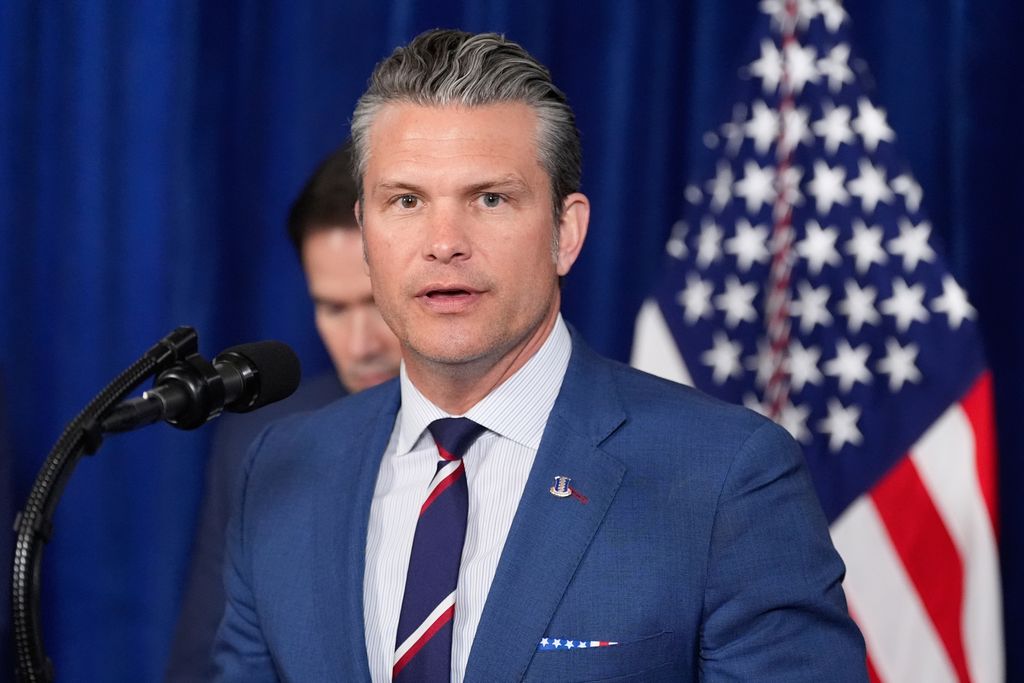
Defense Secretary Pete Hegseth and other top officials have been called on by Congress to answer questions and concerns about the actions — particularly the first one because it involved a follow-up strike that killed two survivors holding onto the wreckage of the vessel hit in the initial attack.
Legal experts have said the follow-on strike may have been unlawful because striking shipwrecked sailors is considered out of line with laws of war. Some lawmakers have called for the Pentagon to publicly release the unedited video of the operation, which Hegseth has said he will not do.
In a Dec. 1 meeting of Trump’s Cabinet, Hegseth said he “watched that first strike live” but that he left before the follow-up strike.
Legal justification for Maduro’s ouster shared with lawmakers
Senators on Tuesday were able to review, in a classified setting, the White House’s still undisclosed legal opinion for having used the military to oust Maduro. It was described as a lengthy document outlining the Trump administration’s rationale.
Exiting the classified facility at the Capitol, Sen. Rand Paul of Kentucky, a Republican who has long opposed U.S. military campaigns abroad, said none of the legal rationale should be kept secret.
“Legal arguments and constitutional arguments should all be public, and it’s a terrible thing that any of this is being kept secret because the arguments aren’t very good,” Paul said.
Sen. Peter Welch, D-Vt., said he is not confident in the legality of the Venezuelan operation and in particular Trump’s plans to “run” the South American country. Secretary of State Marco Rubio has said the control will come from enforcing a quarantine on sanctioned oil tankers tied to Venezuela as the U.S. asserts power over the country’s oil.
“There’s an ongoing question whether the use of military can be for bringing a person to justice,” Welch said, calling Maduro “a really bad guy.”
The legal rationale addressed the military action “but not the current reality that the president is saying we’ll be there for years and that we’re running Venezuela,” Welch said. —WASHINGTON (AP)
_______
Story by LISA MASCARO and KONSTANTIN TOROPIN | Associated Press
Related News
Beckles congratulates TPP on THA victory

Kidnap victims being kept in ‘protective custody’
Pope Leo XIV meets with Venezuelan opposition leader María Corina Machado in a surprise a...
