
KEVON FELMINE
Senior Reporter
With the World Health Organisation reporting a rise in the global disability population, Independent Senator Alicia Lalite-Etienne is urging the Government to enact long-awaited legislation that gives real protection and equity to people living with disabilities.
Lalite-Etienne, who is visually impaired, brought a private members’ motion to the Upper House yesterday, calling on the Government to table a comprehensive national strategic plan with a legislative framework within 12 months.
Although T&T is a signatory to several international treaties, including the United Nations’ Convention on the Rights of Persons with Disabilities (CRPD), she said these commitments remain only policy without domestic law to enforce them.
“Section 4 of the Constitution speaks about equality and rights of all citizens. Without domestic legislation, we are in violation of part of the Constitution. The CRPD 2006 has eight principles, and I am absolutely sure that we are in breach of some of those principles because there is no domestic legislation,” Lalite-Etienne said.
She said people with disabilities (PWD) still faced entrenched institutional, attitudinal and structural barriers that legislation could help dismantle. These barriers affect access to work, healthcare, safety, financial independence and basic inclusion.
“We do not just deserve a national policy. We have a right like any other person within this nation of Trinidad & Tobago. I view this national policy like a dog with no teeth. It will rush you, but it cannot bite,” she said, adding that discrimination thrives when there is no enforceable protection.
A 2011 Central Statistical Office census identified 52,244 people with disabilities, but Lalite-Etienne said the number has risen significantly due to ageing, noncommunicable diseases, the pandemic and conflict-driven injuries. She said people often experience a sudden loss of independence and require support devices or modified workspaces, yet still find systems that exclude them.
While a National Policy for Persons with Disabilities and the Equal Opportunity Act exist, she said, they do not adequately cover the full range of needs and concerns. In 2024, then Minister of Social Development Donna Cox confirmed that a new bill was being drafted to align with the CRPD. By March, Cox reported that the Persons with Disabilities Bill was ready, pending final policy and legislative analysis after consultations with civil society, the Law Association, the Equal Opportunity Commission and people with disabilities.
Responding to the motion, Minister of the People and Social Development Vandana Mohit said the implication that the Government was not acting “decisively and comprehensively” was incorrect. She said significant work had already been completed.
“Legislative advancement is well on the way. Mr President, the motion which calls for a legislative framework in 12 months demands time, but I want to share here today that the Government already has a robust legislative agenda in advanced stages,” Mohit said.
She said the draft PWD Bill has been vetted by the Equal Opportunity Commission, evaluated by the Law Association and is now before the legislative review committee. She maintained that the Government was committed not only to signing conventions but also to operationalising them through policy, institutions and national programmes.
Mohit said government support was evident in disability assistance grants. During fiscal 2025, 21,298 adults received $542 million in disability support, while 4,352 children received $80 million. For fiscal 2026, $640 million has been allocated in addition to other grants and a pending prosthetic camp. She also announced that the National Therapeutic and Resource Centre for Persons with Disabilities in Carlsen Field will begin service on December 1.
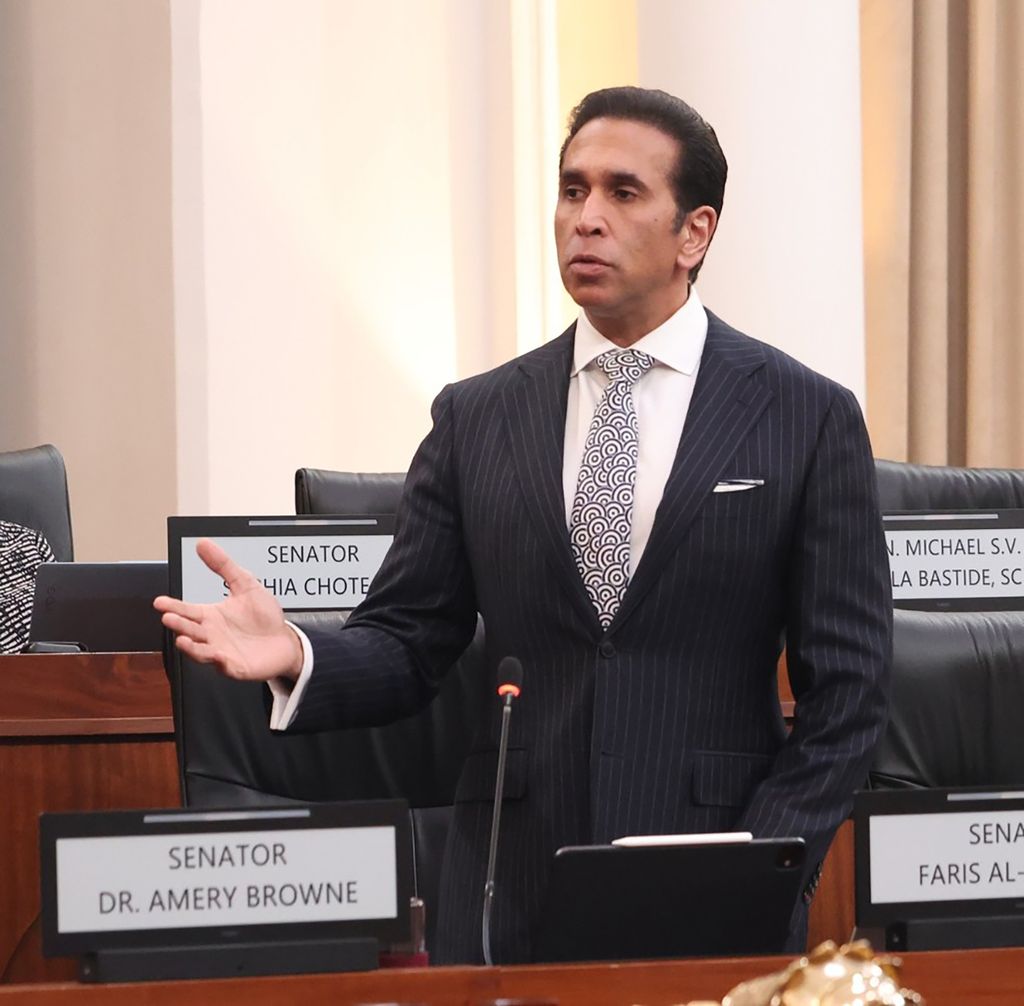
Leader of Opposition Business in the Senate, Dr Amery Browne, said his bench fully supported the motion and noted that draft legislation prepared under former Attorney General Faris Al-Rawi was already available to the Government. He said the debate should be treated as an opportunity for bipartisan cooperation, not political positioning.
He questioned why there would be hesitation to prepare and table a comprehensive national strategic plan when it could only help vulnerable groups. Browne emphasised that disability prevention must form part of the equation, noting that rising diabetes rates lead to amputations, visual impairment and organ failure. He added that an ageing population also increases sensory impairment and heightens the need for accessible services.
Browne highlighted everyday discrimination faced by people with disabilities, from taxis refusing to stop to abuse in institutions and homes. He noted that some require sexual and reproductive healthcare and are denied it due to misconceptions about disability.
He said it was troubling that new businesses continue to open without proper accessibility, showing how far the country still has to go.