Fire disrupts UN climate talks just as negotiators reach critical final days
 20 November 2025
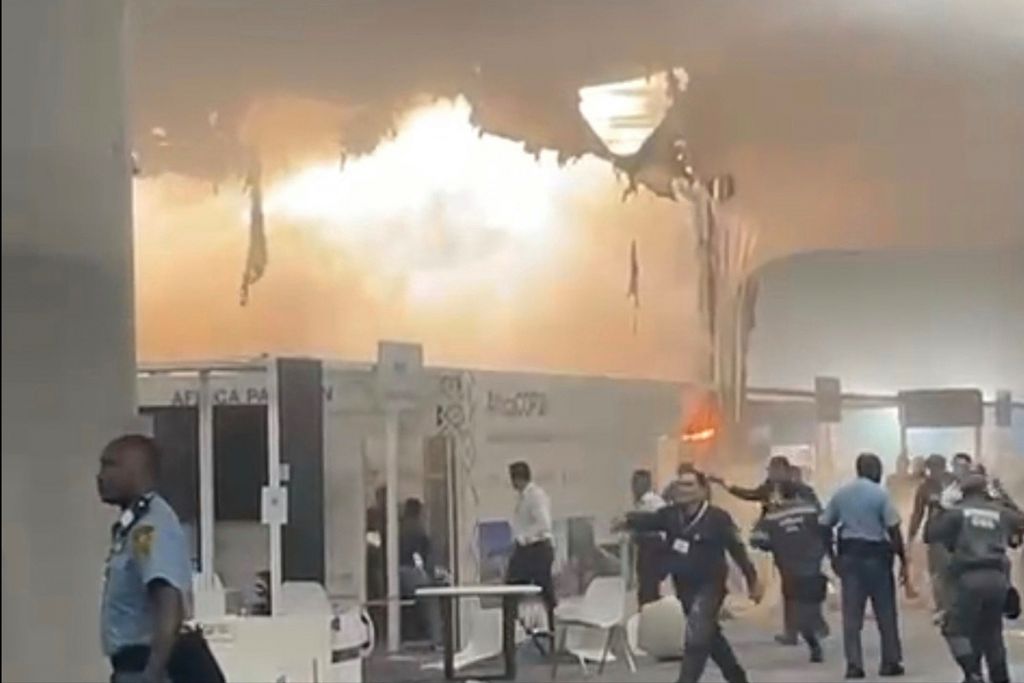

Fire disrupted United Nations climate talks in Brazil on Thursday, forcing evacuations of several buildings and delaying already sluggish negotiations by most of a day with no major agreements even close. Officials said 13 people were treated for smoke inhalation.
The fire erupted in an area of pavilions where sideline events are held during the annual talks, known this year as COP30. The fire was quickly brought under control, but fire officials ordered the entire site evacuated for safety checks and it wasn’t clear when conference business would resume.
The fire could cost significant time if the talks don’t resume until Friday’s scheduled final day. The presidency of the talks had planned to have ministers and diplomats work late Thursday.
It was also possible that only top negotiators would be allowed back at night for a slimmed-down session.
The fire came at a critical time. The COP30 presidency had been working on what was hoped to be a next-to-last draft of an agreement on four contentious topics involving money, cutting fossil fuel emissions and trade. Leaders had originally wanted a deal on this tough interconnected package by Wednesday, while Brazil’s president and the United Nations secretary-general were on site, but it didn’t come together.
“It definitely puts a hold on negotiations for a period of time,” said veteran climate negotiations observer Alden Meyer of the European think-tank E3G. He said they could still get back on track but ending Friday, as scheduled, doesn’t look likely.
“It means there is a lot to do with very little time. There were already huge gulfs to bridge and this won’t help,” said Teresa Anderson, climate justice lead at ActionAid.
Mohamed Adow, another COP veteran and director of PowerShift Africa, chose to see some positive in people helping each other when the fire erupted.
“That spirit is precisely what climate action demands,” Adow said. “If we can respond to the planet’s emergencies with the same unity shown in that tense moment, COP30 might yet be remembered not for an incident, but for a turning point.”
Meyer wasn’t convinced.
‘’People tend to feel a little closer during an emergency like this,” Meyer said. “But there are pretty deep fundamental interests at play.’’
Meyer worried that with limited time and lack of agreement so far, the Brazilian leadership might opt for the lowest common denominator and “you could get something that’s so weak that no one wants it.’’
UN’s secretary-general says compromise is OK
A few hours before the fire, U.N. Secretary-General António Guterres urged countries to compromise and “show willingness and flexibility to deliver results,” even if they fall short of the strongest measures some nations want.
“We are down to the wire and the world is watching Belem,” Guterres said, asking negotiators to engage in good faith in the last two scheduled days of talks, which already missed a self-imposed deadline Wednesday for progress on a few key issues. The conference, with this year’s edition known as COP30, frequently runs longer than its scheduled two weeks.
“Communities on the front lines are watching, too — counting flooded homes, failed harvests, lost livelihoods — and asking, ‘how much more must we suffer?’” Guterres said. “They’ve heard enough excuses and demand results.”
On contentious issues involving more detailed plans to phase out fossil fuels and financial aid to poorer countries, Guterres said he was “perfectly convinced” that compromise was possible and dismissed the idea that not adopting the strongest measures would be a failure.
Guterres was more forceful in what he wanted rich countries to do for poor countries, especially those in need of tens of billions of dollars to adapt to the floods, droughts, storms and heat waves triggered by worsening climate change. He continued calls to triple adaptation finance from $40 billion a year to $120 billion a year.
Officials from nations battered by natural disasters gave emotional testimony earlier this week imploring the world to stop talking and start acting.
Delivering overall financial aid — with an agreed goal of $300 billion a year — is one of four interconnected issues that were initially excluded from the official agenda. The other three are: whether countries should be told to toughen their new climate plans; dealing with trade barriers over climate and improving reporting on transparency and climate progress.
More than 80 countries have pushed for a detailed “road map” on how to transition away from fossil fuels, like coal, oil and natural gas, which are the chief cause of warming. That was a general but vague agreement two years ago at the COP in Dubai.
Guterres kept referring to it as already being agreed to in Dubai, but did not commit to a detailed plan, which Brazilian President Luiz Inácio Lula da Silva pushed for earlier in a speech.
BELEM, Brazil (AP)