
Senior Reporter
shaliza.has[email protected]
Approximately 5,000 maxi taxi operators—the lifeblood of the nation’s public transport system – will come to a planned halt today in protest of long-standing grievances.
With these maxi taxis off the roads for the next three days, thousands of commuters will have to look for alternative transport options such as Public Transport Service Corporation (PTSC) buses, taxis and PH cars to get to and from their destinations.
This move can lead to a dip in productivity for businesses, slow down the economy and affect the turnout at schools.
The strike will start at 5 am with a motorcade in Tarouba and end in Port-of-Spain, with maxi taxi drivers standing in solidarity with each other.
The planned action has already triggered concern and worry from commuters who rely on the essential service.
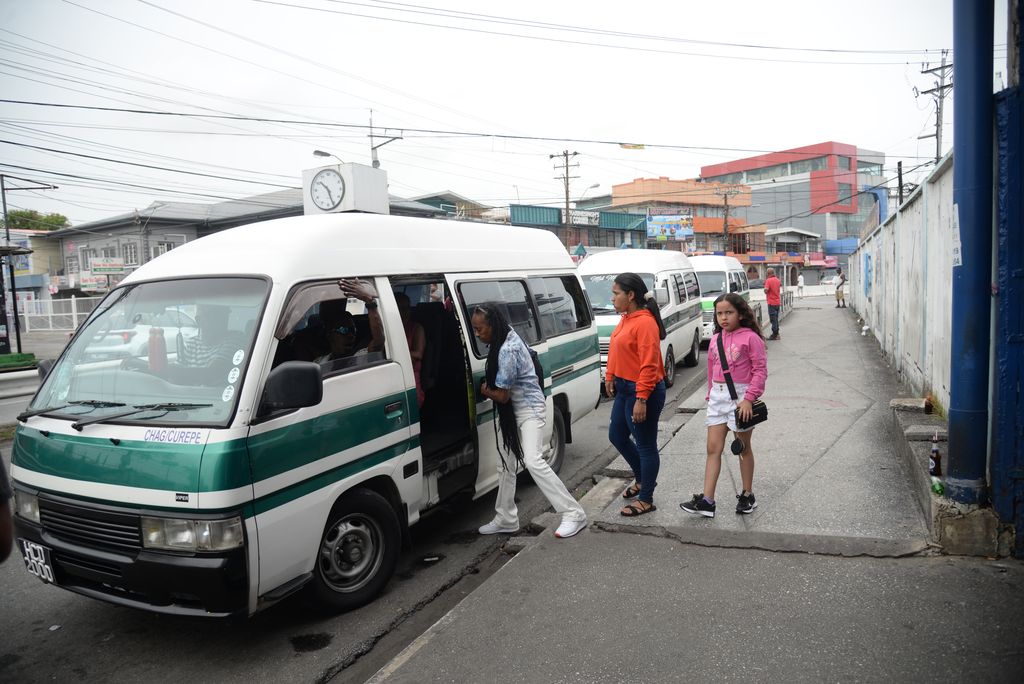
Maxi taxi drivers provide transport services to 14 zones across the country through their red, green, yellow, brown and black band maxi taxis.
Roughly 3,500 of these maxi taxis operate daily from Chaguanas to San Fernando and along the East-West corridor.
Association of Maxi Taxi Trinidad and Tobago (AMTTT) secretary Vickash Kissoondath told Guardian Media yesterday that staging this boycott was the last thing the operators wanted to do.
“We didn’t want to reach this stage. But things have come to a breaking point.”
He admitted that thousands of commuters, in particular the working class, are likely to be affected.
At Chaguanas and City Gate yesterday, many commuters admitted they were not aware of the planned strike.
Others felt the impending boycott was unwarranted.
As Jemiah Massiah, 23, walked down the steps, leading to the Port-of-Spain/ Arima loading bay at City Gate, she said the news of the shutdown was worrying and concerning, as she depended on the maxi taxi service to attend classes at the University of the West Indies, St Augustine campus.
“The maxis are very important, and it will be very hard without them for the next three days,” she complained.
Massiah said she would have to use another mode of transport, preferably a taxi, which would be far more expensive.
While cheaper, she said the PTSC was not reliable and efficient with its service.
“These issues should not be happening. The public relies a lot on the maxi taxi services. I find it is an inconvenience for us ... the public. But I know the drivers have a lot of issues that they have been raising and that needs to be resolved. The Government needs to do a little better when it comes to stuff like this.”
Another commuter, Edwin Rivas, said the strike would be devastating for the working class, who have no other means of transport.
“I hope PTSC gets the bus service to run a good way to facilitate those who can’t get a maxi,” Rivas said.
In the bustling borough of Chaguanas, Wayne Quashie sat in a green band maxi at Busy Corner waiting for it to be filled with passengers.
With beads of perspiration running down his face, Quashie said maxi taxis are all that he uses.
He disagreed with the operators for withholding their services.
“It is not right because of the population ... not everybody is able to withstand that because some people have different schedules compared to others. I can’t do nothing because people in Trinidad doh have a voice really.”
David Guerra also complained that while he was in support of the operators fighting for better working conditions, he felt three days was too long.
“It’s going to cripple this country.”
Over the next 72 hours, Kissoondath said the country’s productivity level could drastically slide.
“Again, we go down to the productivity of the country tomorrow (today). Let’s say from being 80 per cent productive on a normal day, I think it might drop down to 20 per cent.”
Kissoondath denied the impending strike was a way of holding the travelling public to ransom.
“I wouldn’t say hold the country to ransom. But we are trying to plead with our passengers ... our commuters to understand the problems that we face on a daily basis for years now. And nothing has been done about it. We have been meeting the relevant authorities through the correct channels, through the right ministries, through the line minister and nothing.”
He said the population needs to understand how serious their issues have become.
Kissoondath said they held numerous meetings with the officials of the Ministry of Transport for the past five months to have their plights resolved.
“It has only been promises. I was highly disappointed.”
Kisoondath said all they have been receiving is a round-around.
For weeks, he said, maxi taxi operators have been driving around with blue ribbons tied onto their vehicles “as a silent protest.”
They thought this would have triggered some results. However, nothing materialised.
“What pushed us over the edge? We have a minister right now of transport and civil aviation who thinks that we are a joke and we are not a force to be reckoned with. We are going to show him exactly what maxi taxis do for T&T.”
He hoped by withholding their services, it would grab the Government’s attention and bring their problems to a grinding halt.
“We want things signed, sealed and stamped.”
Kissoondath said he would wait to see what contingency plan PTSC would provide for commuters requiring transport.
Yesterday, Guardian Media sent a WhatsApp message to Minister of Transport and Civil Aviation Eli Zakoor regarding the planned shutdown, but he did not respond up to press time.
Maxi Taxi Association’s Demands
*Increase the highway speed limit for maxi taxis from 65 km/h to 80 km/h.
*Address escalating crime affecting operators and passengers.
*Crack down on illegal PH taxi operations.
*Pay outstanding monies owed to drivers for transporting schoolchildren.
* Upgrade and improve maxi taxi hubs and terminals.
*Create a system to allow operators to make NIS contributions.
*Deliver on commitments made during meetings with transport officials.